Why Growth Should Own AI Search Visibility (Not SEO)
Video: Why Growth Should Own AI Search Visibility (Not SEO)
AI search is a measurable channel, and channels live in Growth. SEO is a tactic, not a channel owner — the skills, KPIs, and operating model all point to Growth ownership.
Full transcript
Hi, I'm Marcus, on the Indexable AI team. Here's a take that'll ruffle feathers: AI search visibility shouldn't be owned by SEO. It should be owned by Growth. Let me make the case in three lines. AI search is now a measurable channel, not a future trend. And channels live in Growth. SEO is a tactic, not a channel owner. The skills, the KPIs, and the operating model all point to Growth. Growth already runs experiments, owns funnel metrics, and moves budget across channels. AI visibility fits that model exactly. When Growth owns it, AI visibility gets treated like a channel: targets, attribution, and a seat at the revenue table. So here's what it means for you: if AI visibility is buried in an SEO checklist, it stays a tactic. Give it to Growth, and it becomes a channel that compounds. See how to run AI visibility like a channel, at Indexable AI dot com.
- The argument in three lines
- A question most Growth teams aren't asking yet
- What changed at the funnel top?
- Why is AI search a channel, not a tactic?
- What does AI search citation actually require?
- How do the KPIs differ?
- The Three Pillars framework
- What does ownership look like in practice?
- What can Growth leaders do this quarter?
- What we're seeing across categories
- The closing question
The argument in three lines
- AI search is now a measurable channel — not a future trend.
- Channels live in Growth. SEO is a tactic, not a channel owner.
- The skills, the KPIs, and the operating model all point to Growth ownership.
A question most Growth teams aren't asking yet
AI search is a measurable channel. ChatGPT has 900 million weekly active users (TechCrunch, Feb 2026)[1]. Google AI Mode has 75 million daily active users (Search Engine Journal)[2]. Roughly 60% of Google searches end without a click (SparkToro)[3]. Seer Interactive's analysis of 25.1 million impressions found that 93% of Google AI Mode queries generate no outbound clicks at all[7]. Perplexity, Claude, and Gemini are visible inside enterprise buyer journeys.
Most Growth orgs have not claimed ownership of this channel. By default, it has drifted into the SEO function. That default is worth a closer look.
The argument here is structural, not personal. AI search visibility belongs to Growth — not because SEO leaders cannot do the work, but because the channel itself does not fit the SEO operating model. The skills required, the KPIs that matter, and the cross-functional reach all sit in a Growth playbook.
This piece is for VPs of Growth, Heads of GTM, and CMOs at B2B SaaS companies who want to understand what changes when AI search becomes a real pipeline source.
What changed at the funnel top?
A B2B buyer in 2022 typed a category query into Google. The buyer scanned the first three organic results. The buyer clicked once or twice. The brand that ranked got the click.
The same buyer in 2026 types a longer prompt into ChatGPT or Perplexity. The buyer reads a synthesized answer. The buyer notices which brands are named. The buyer clicks zero or one time.
The mention is doing the work the click used to do. The mention IS the awareness moment.
This is not a future trend. Recent research reverse-engineered 42,971 AI citations across major answer engines[4]. The finding: brand mentions in answer engines now drive measurable consideration. Top-cited content shares specific traits — structured formatting, dense information, ten-word median sentence length, and clear answer leads in the first paragraph.
The citation IS the win. Seer Interactive analyzed 25.1 million impressions across 3,119 queries. Brands cited inside Google AI Overviews see 35% more organic clicks than brands left out. Brands cited inside paid AI surfaces see 91% more paid clicks.[7] Being mentioned is what wins the consideration moment now, not the click that follows.
The funnel top has been rewired. The question is who inside the org owns the new motion.
Why is AI search a channel, not a tactic?
This is the structural argument. It is the one that decides ownership.
A channel is a discrete pipeline source. It has its own attribution model, its own optimization loop, and its own scaling decisions. Paid search is a channel. LinkedIn Ads is a channel. Content marketing is a channel. Partnerships is a channel.
A tactic is the work performed inside a channel. Ad creative is a tactic. Landing page design is a tactic. Keyword research is a tactic.
SEO has historically been a tactic that lived inside the organic search channel. That made sense when the channel was simple: rank, click, convert. Inside that loop, an SEO team could optimize and report on rankings.
AI search visibility is a different channel. It has its own attribution surface (share of model, citation rate). It has its own optimization loop (entity authority, structured data depth, prompt fan-out coverage). It has its own measurement infrastructure (Brand Radar, GEO platforms, custom monitoring).
A new channel does not get folded into an existing tactic. A new channel gets a channel owner. And channel owners — by design and operating model — sit in Growth/GTM.
What does AI search citation actually require?
The skill stack is the second reason ownership matters.
SEO leaders have built their craft around Google's ranking algorithm. The mental model is rank position, link equity, on-page optimization, technical crawlability, and internal linking architecture. This is a serious skill set. It is the right skill set for winning Google's organic SERP.
AI search citation requires a different skill set. Citation in an LLM answer depends on entity authority signals, structured data depth, content chunkability, prompt fan-out coverage, and AI-readable answer leads. AirOps' Fan-Out Effect study (16,851 queries, 353,799 pages)[5] found a consistent pattern in the most-cited content: seven to ten question-format H2s, JSON-LD schema, tables and lists, front-loaded claims within the first 35% of the page.
The work is closer to brand strategy combined with structured data engineering than to keyword optimization. Some SEO leaders will adapt and learn this work. Many will. But the operating model that scales it — hypothesis, test, measure, iterate, attribute to pipeline — is the operating model Growth/GTM already uses for every channel it owns.
How do the KPIs differ?
The third structural break is dashboards.
An SEO dashboard surfaces rank position, click-through rate, organic sessions, keyword coverage, and traffic value. These metrics describe Google ranking performance.
An AI search dashboard surfaces share of model (the percentage of relevant prompts in which the brand appears), citation rate (when mentioned, whether the brand is linked or sourced), generative position (where in an answer the brand is ranked), and sentiment (positive, neutral, negative, plus hallucination rate). These metrics describe answer-engine performance.
These are not the same metrics. A B2B SaaS team can grow Google rankings while losing AI citation share. Both can be true in the same quarter. Reporting against one does not protect the other.
Growth orgs already operate channel-level dashboards. Paid search ROAS, LinkedIn cost-per-lead, content engagement by stage — these are the kinds of cross-functional reports a Growth/GTM leader runs every month. Adding an AI search dashboard is the same operating motion. The infrastructure is familiar.
The Three Pillars framework
A useful starting frame, drawn from GEO measurement research[6]:
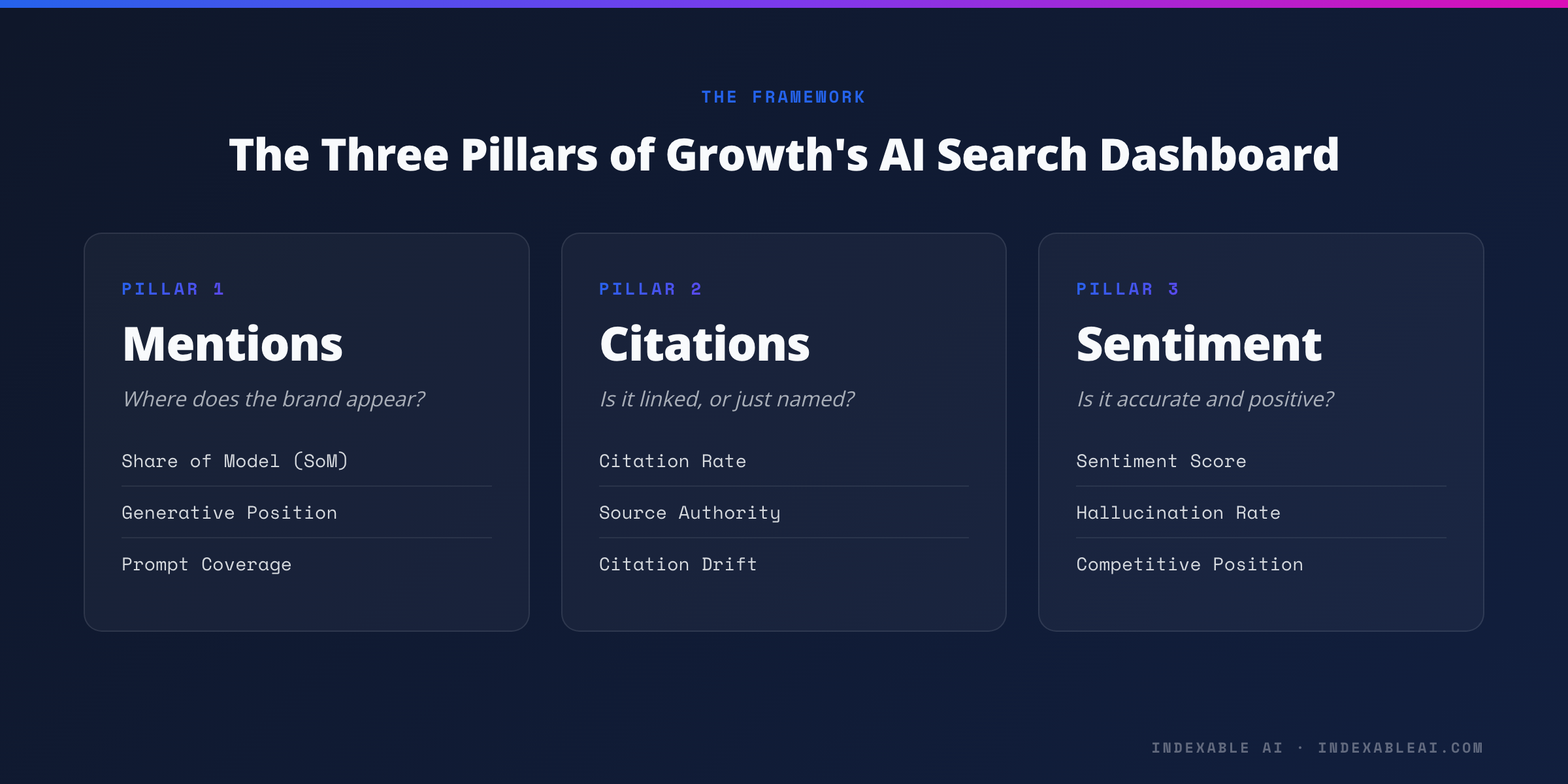
Pillar 1 — Mentions. Where does the brand appear in answer engines across the prompts that matter? This is share of model — the answer-engine equivalent of share of voice.
Pillar 2 — Citations. When the brand is mentioned, is it cited and linked, or just named? Citation is the source of attribution. Bare mentions are weaker signals.
Pillar 3 — Sentiment. When the brand is named, is the framing accurate and positive? Hallucination rate matters here. A frequently-cited brand with negative or inaccurate sentiment is in a worse position than a less-cited brand with clean sentiment.
These three pillars become the instrument panel for the channel. The cadence is monthly. The owner is Growth/GTM. The infrastructure is the same kind that already exists for paid channels.
Is your site I/O ready?
Score your domain against the three legs of AI search visibility — Brand, Technical SEO, Content. Get a 0–100 score and a stack-ranked priority list of what to fix first.
Take the audit →What does ownership look like in practice?
The reporting question is concrete. Three patterns are emerging in B2B SaaS organizations that treat AI search as a channel.
Pattern 1.
The Growth/GTM leader owns the share-of-AI-search KPI directly, the same way the leader owns paid-channel ROAS. SEO is one tactical input, alongside structured data engineering, brand authority, and AI-readable content production.
Pattern 2.
A new role — sometimes titled Head of AI Search, sometimes Head of Discovery — reports into Growth. The role spans organic, AI search, and the structured-data layer. The legacy SEO team rolls under this role.
Pattern 3.
The existing SEO leader broadens scope to Head of Organic and AI Search, but the reporting line shifts to Growth/GTM. The work expands, the title expands, the dashboard expands, and the channel-level ownership becomes explicit.
All three patterns share one thing. The KPI sits in Growth. The dashboard sits in Growth. The cross-functional escalation path runs through Growth.
What can Growth leaders do this quarter?
Three steps are useful for any B2B SaaS Growth leader who wants to bring AI search into the channel mix this quarter.
Step 1. Audit AI visibility.
Pull data on brand appearance across ChatGPT, Perplexity, Claude, Gemini, and Google AI Overviews for the top 20 high-intent prompts in the category. Compare share of model to the top three competitors. This produces the baseline.
Step 2. Map ownership.
Identify who reports on AI search citation rate today. In most orgs, the honest answer is nobody. Decide whether AI search ownership lives with the existing SEO leader, with a new role, or with the Growth/GTM leader directly. Make the call explicit.
Step 3. Stand up a measurement loop.
Run a monthly Three Pillars review at the same cadence as paid-channel reviews. Track the trendline. Decide which pillar to invest against first based on the gap-to-competitor data.
What the Three Pillars measure, the 3-Legged GEO Stool[8] produces. Brand, Technical SEO, and Content — the three legs that hold up AI citation share. Removing any one collapses the stool. The 3-Legged GEO Stool framework covers the execution layer that turns the dashboard into outcomes.
This is a quarter of work, not a year. The infrastructure is available.
What we're seeing across categories
The variance is dramatic. Across categories we've audited, brands in the same competitive set can differ in AI citation share by two orders of magnitude or more — not five percent, not twenty percent, but tens of times over. Two brands with comparable revenue, comparable product surface, and comparable Google ranking performance can have radically different AI search outcomes. The variance reflects ownership clarity more than budget.
Companies that have treated AI search as a channel typically see compounding pipeline impact within 60 to 90 days. The compounding effect is real: every additional citation makes the brand more retrievable in future prompts. Companies that have not yet claimed ownership tend to stay flat as competitors invest.
The closing question
Every Growth leader is measured on pipeline. Pipeline starts with brand discovery. Brand discovery now happens inside answer engines as often as inside Google's organic SERP, and the share is shifting.
The question is not whether AI search visibility matters. The data has settled that. The question is who inside your org owns it.
If you cannot name the person, the channel is being neglected. That is recoverable in a quarter. The first move is making the ownership call.
Vijay Vasudevan
Vijay Vasudevan is Founder of Indexable AI, the agentic SEO platform building AI search visibility for B2B SaaS. He previously led SEO at Uber and was the first SEO hire at Uber Eats. He has generated $1B+ in organic pipeline across Uber, Zendesk, RingCentral, and Williams-Sonoma Group.
Further reading
- TechCrunch — ChatGPT reaches 900M weekly active users (Feb 27, 2026)
- Search Engine Journal — AI Mode Hits 75M Users
- SparkToro — 2024 Zero-Click Search Study
- Daniel Shashko — Reverse-Engineering 42,971 AI Citations (HackMD, March 2026)
- AirOps — The Fan-Out Effect (16,851 queries, 353,799 pages)
- Foundation Inc — GEO Metrics framework
- Seer Interactive — AIO Impact on Google CTR (25.1M impressions, 3,119 queries)
- Indexable AI — The 3-Legged GEO Stool (execution framework)
Want a free AI visibility audit of your domain?
Drop your work email and website. We'll audit your domain against the three legs of AI search visibility — Brand, Technical SEO, Content — and ship a stack-ranked findings document within 24 hours. We do the work first. Talk later.
Built by professional SEOs in San Francisco · Your email goes to Vijay personally · No spam, no sharing