What is Agentic SEO?
Agentic SEO is search optimization run by autonomous AI agents that plan, execute and check SEO and AI-search work, while people set direction and approve what ships. It differs from SEO automation, which repeats fixed rules, and from AI-assisted SEO, which only suggests. This page walks through the 4 levels of SEO technology, why Level 4 is the structural shift, and how to deploy it without losing human authority.
This is not AI-assisted SEO. This is not SEO automation. This is a fundamental shift in how search optimization operates.
What Makes Agentic SEO a Fundamental Shift?
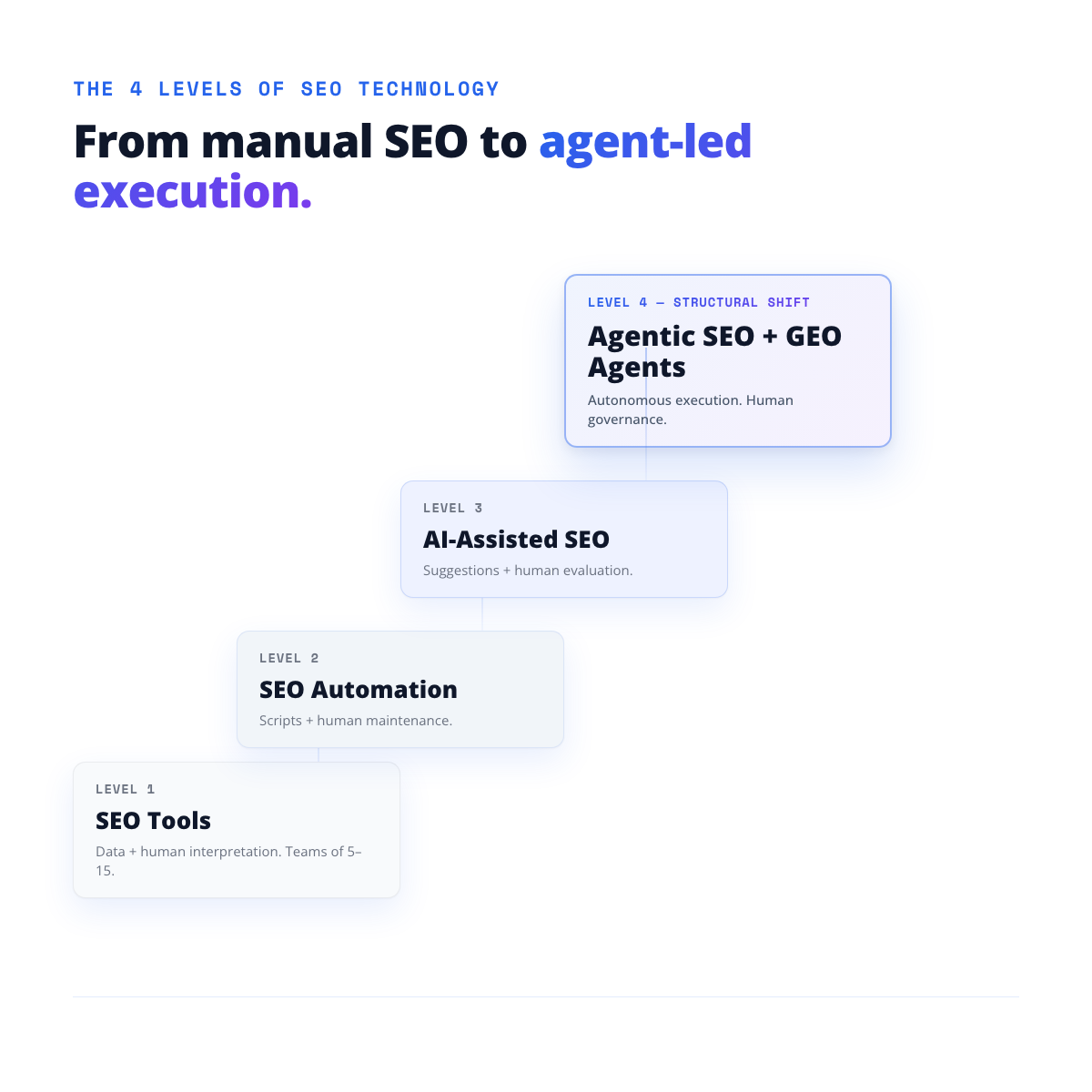
Four levels of SEO technology. Only one removes the human execution bottleneck while preserving human authority.
SEO Tools
Traditional SEO tools provide data. Humans interpret and act.
SEO Automation
SEO automation scripts execute predefined rules. Humans build and maintain.
AI-Assisted SEO
AI-assisted SEO generates suggestions. Humans evaluate and implement.
Agentic SEO
Agentic SEO systems reason, plan, execute, and adapt. Humans set direction and govern.
The distinction matters. Agentic systems do not wait for instructions at every step. They receive a goal, determine the path, execute the work, and report outcomes. The human provides the strategic vector. The agent executes the journey.
What Are the Two Definitions of Agentic SEO?
The term "Agentic SEO" carries two meanings. Both matter.
This is the primary definition. Autonomous AI agents perform SEO workflows end-to-end. Keyword research. Content creation. Technical optimization. Performance monitoring. Humans direct. Agents execute.
This definition answers: "How do I get SEO done faster and at scale?"
AI agents now search on behalf of users. ChatGPT researches products. Perplexity compiles comparisons. Google AI Overviews summarize options. These agents evaluate your content before users ever see it.
This definition answers: "How do I ensure AI agents recommend my brand?"
Traditional SEO optimized for human searchers. Agentic SEO optimizes for AI agents that serve human searchers. This is the Agentic Web — a phase where AI agents actively operate on behalf of users.
Gartner predicts that by 2028, 90% of B2B buying will be AI agent intermediated (Gartner, 2025). The shift is not theoretical. It is happening.
What Are the Three Defining Characteristics?
Agentic SEO systems share three characteristics. These separate them from every previous approach.
Multi-Step Workflow Execution
An agentic system does not perform isolated tasks. It executes complete workflows. When given a goal, the system analyzes the current keyword portfolio, identifies gaps against competitors, prioritizes opportunities by traffic potential and difficulty, creates content briefs, produces optimized content, audits technical health, deploys changes, monitors performance, and adjusts strategy based on results. Each step triggers the next. No human intervention required between steps.
Autonomous Interpretation of Unstructured Data
SEO data is messy. SERPs change daily. Competitor content varies wildly. Crawl logs contain millions of entries. Rule-based automation cannot handle this complexity. Agentic systems interpret unstructured data without explicit rules. They read a SERP and understand competitive positioning. They analyze competitor content. They identify differentiation opportunities. The system does not ask "what should I look for?" It knows what matters.
Guardrailed Decision-Making with Human Oversight
Agentic does not mean unsupervised. Agentic SEO systems make decisions within human-defined guardrails. Every decision is logged with the data behind it, so a person can trace why the agent acted. Anything that ships passes a human approval gate.
What Are AI Agents for SEO?
Understanding how AI agents for SEO work clarifies the difference. This approach differs from previous technologies.
What Makes an AI Agent Different from AI Tools
AI tools respond to prompts. You ask a question. The tool answers. You ask another question. The tool answers again.
AI agents operate differently. You provide a goal. The agent determines the steps. The agent executes. The agent evaluates results. The agent adjusts approach.
This distinction matters for SEO. Traditional AI tools accelerate individual tasks. AI agents complete entire workflows autonomously.
The Agentic Search Paradigm
Agentic search describes how AI systems retrieve and synthesize information. ChatGPT does not return ten blue links. It synthesizes information from multiple sources. It delivers a coherent answer.
Your content must work within this paradigm. Facts must be self-contained. Claims must be citation-worthy. Measuring whether they succeed takes two scores, not one — the practice of Dual-Scoring.
Google's SAGE researchers call this information co-location: when every fact a question needs sits in one document, a search agent can answer from that document alone.
Agentic SEO systems optimize for this reality. They structure content for agent retrieval, not just human reading.
How Did SEO Evolve from Tools to Agents?
Agentic SEO represents the fourth era. Search optimization technology has evolved through distinct phases.
SEO Tools
The first era gave us data visibility. SEO tools showed what was happening in search. Keyword volumes. Backlink profiles. Ranking positions. Humans did all the work. Tools provided information.
Limitation: Human bandwidth constrained execution speed.
SEO Automation
The second era automated repetitive tasks. Screaming Frog crawled sites automatically. Templated reports generated weekly. Rank tracking updated daily. Rule-based scripts handled predictable workflows.
Limitation: Rules could not handle complexity. Every edge case required new rules. Maintenance burden grew exponentially.
AI-Assisted SEO
The third era introduced large language models. ChatGPT drafted content. AI tools suggested optimizations. But humans still made every decision. AI suggested. Humans evaluated. Humans approved.
Limitation: AI assistance did not reduce decision load. Humans still carried the full execution load.
Agentic SEO
The fourth era offloads execution to agents. It preserves human authority for strategy. Agents do not suggest. They execute. They operate within approved parameters. They interpret data autonomously.
The result: months of execution compressed into days.
What Are the Five Characteristics of Agentic Systems?
What makes a system truly "agentic"? Five characteristics define the category.
Goal-Oriented Autonomy
Given a goal, the agent determines the steps. A traditional tool requires explicit instructions. Example: Research these 50 keywords. Check these 20 competitors. Analyze these 10 pages. An agentic system requires: "Identify opportunities to increase organic traffic by 30%." The agent decides which keywords to research. It determines which competitors matter. It identifies which pages need attention.
Multi-Step Reasoning
Agentic systems break complex tasks into sub-tasks. They sequence them logically. The system does not execute steps randomly. It understands dependencies. Keyword research precedes content briefs. Content briefs precede production. This reasoning happens internally. No human needs to specify the sequence.
Environmental Awareness
Agentic systems interpret their environment without explicit programming. They read SERPs and understand competitive dynamics. They analyze content and identify gaps. They recognize patterns in performance data. This awareness extends to changing conditions. When Google updates its algorithm, the system detects ranking shifts. It adjusts strategy. When competitors publish new content, the system responds.
Adaptive Execution
When Plan A fails, agentic systems try Plan B. A content piece underperforms. The system analyzes why. It identifies improvement opportunities. It executes optimizations. Technical fixes that cause issues get rolled back. This adaptation happens without human intervention. The system monitors outcomes. It adjusts approach continuously.
Human-in-the-Loop Governance
Agentic systems operate within human-defined boundaries. Strategic decisions require human approval. Budget allocations require human sign-off. The governance model ensures accountability. Humans remain responsible for outcomes. Agents execute within approved parameters.
How Do Tools, Automation, AI-Assisted, and Agentic SEO Compare?
| Dimension | SEO Tools | SEO Automation | AI-Assisted SEO | Agentic SEO |
|---|---|---|---|---|
| Human Role | Does all work | Builds and maintains rules | Evaluates and approves | Sets direction and governs |
| System Role | Provides data | Executes predefined rules | Generates suggestions | Reasons, plans, executes, adapts |
| Decision Making | Human only | Rule-based | Human with AI input | Agent within guardrails |
| Workflow Scope | Single tasks | Predefined sequences | Individual outputs | End-to-end execution |
| Adaptability | None | Requires new rules | Requires human judgment | Autonomous adjustment |
| Scalability | Limited by human bandwidth | Limited by rule complexity | Limited by approval bottleneck | Limited only by compute |
| Execution Speed | Weeks to months | Days to weeks | Days | Hours to days |
How Does Agentic SEO Work in Practice?
Abstract definitions matter less than concrete application. Here is how agentic SEO operates in practice.
Scenario: Improve Organic Traffic for a Keyword Cluster
A B2B software company wants to increase organic traffic for "enterprise project management" keywords.
Traditional Agency vs. Agentic Execution Timeline
Account manager meets with client. Discusses goals. Aligns on strategy.
SEO analyst researches keywords. Identifies 200 potential targets. Creates prioritization spreadsheet.
Strategist reviews analysis. Selects 50 keywords for focus. Creates content calendar.
Content team writes 10 articles. Each goes through draft, review, revision cycles.
Technical team audits target pages. Creates fix tickets. Developers implement.
Content publishes. Links build. Performance monitoring begins.
SEO Strategy Agent receives goal. Analyzes current keyword portfolio. Identifies gaps against top 10 competitors. Prioritizes 50 opportunities by KOB score.
AI Content Agent creates briefs for top 20 opportunities. Maps each to buyer journey stage. Defines narrative approach.
AI Content Engineer produces 10 content pieces. Each optimized for human engagement and AI citation. CRAFT quality framework applied.
AI Technical SEO Agent audits all target pages. Identifies 47 technical issues. Prioritizes by impact.
SEO Software Engineer deploys fixes. Schema markup added. Core Web Vitals addressed.
SEO Data Agent establishes performance baselines. Monitoring begins.
GEO Agent monitors AI Visibility. Agents continue optimization loop.
Position Your Domain for the Agentic Web
The enterprises that deploy agentic SEO first will own the next decade of search.
Talk to an ArchitectWhy Do Agentic Systems Outperform Traditional Approaches?
Execution Speed
Traditional agencies operate on human timelines. Meetings require scheduling. Reviews require availability. Revisions require cycles. Agentic systems execute in parallel. While one agent analyzes keywords, another audits technical health. No scheduling. No waiting. No cycles.
Consistency
Human output varies. Energy levels fluctuate. Attention drifts. Quality depends on who works on your account and when. Agentic systems apply the same rules and checks on every run, so quality does not vary by day or by person.
Scalability
Scaling a traditional agency requires hiring. Hiring requires recruiting, training, managing. Headcount grows linearly with workload. Agentic systems scale with compute. Ten keywords or ten thousand keywords. The system processes both.
Availability
Agencies operate during business hours. Questions wait until Monday. Urgent issues wait until someone checks email. Agentic systems operate 24/7. Algorithm updates trigger immediate response. Performance issues are detected and addressed continuously.
Knowledge Retention
When agency staff leave, knowledge leaves. New team members require onboarding. Context transfers imperfectly. Agentic systems retain everything. Every analysis, every decision, every outcome persists. No knowledge loss. No onboarding delays.
What Role Does Human Oversight Play in Agentic SEO?
Agentic does not mean autonomous. The distinction is critical. Fully autonomous systems operate without human involvement. Agentic systems with human-in-the-loop operate differently. Humans remain in control.
What Humans Control vs. What Agents Execute
Strategic Direction
What does success look like? Which markets matter? What brand voice applies? Which topics are off-limits? Humans define the strategic vector. Agents execute within that vector.
Guardrails
What actions are permitted? What budget limits apply? Which changes require approval? What quality thresholds must be met? Humans set boundaries. Agents operate within boundaries.
Approval Gates
Which outputs require human review before deployment? What decisions need sign-off? When should agents escalate? Humans define checkpoints. Agents pause at checkpoints for approval.
Course Correction
When should strategy change? What new priorities have emerged? Which previous assumptions were wrong? Humans adjust direction. Agents adapt to new direction.
Execution Velocity
24/7 operation. No scheduling. No waiting. No cycles.
Data Processing at Scale
Millions of data points analyzed, interpreted, and acted upon.
Pattern Recognition
Across competitors, SERPs, content — identifying what humans miss.
Consistent Output
The same rules and checks on every run.
The Human-Agent Partnership Model
How Is SEO Shifting from Rankings to Citations?
Traditional SEO measured rankings. Position 1 through 10. Clicks and traffic. Agentic SEO measures citations.
When ChatGPT recommends solutions, are you mentioned? When Perplexity compiles options, are you cited? When AI Overviews summarize comparisons, are you included?
Research on AI citations points to different signals than classic rankings:
Freshness matters too, though unevenly: across 17 million citations, AI assistants cited content 25.7% fresher than organic results (Ahrefs, 2025). Optimizing for citations requires different tactics than optimizing for rankings. Agentic SEO systems understand these differences and optimize accordingly.
Where Is Google Heading with AI Search?
Google is not waiting for the agentic future. It is building the infrastructure now.
Google-Agent: AI Agents Get Their Own Identity
On March 20, 2026, Google introduced Google-Agent as a new user agent. This identifier appears in server logs when AI agents visit your site on behalf of users.
This is not a background crawler. When you see Google-Agent in your logs, a real person delegated a task to an AI agent — and that agent visited your site to complete it.
Google’s first named example was Project Mariner, its browser agent, which could run up to ten tasks at a time. Google shut Mariner down on May 4, 2026; the user agent remains for Google-hosted agents.
What this means for SEO: Your site must be accessible to AI agents. Check that firewalls and CDN configurations do not block Google-Agent requests.
How Indexable AI prepares you: The AI Technical SEO Agent monitors server logs for Google-Agent traffic, audits bot access configurations, and ensures AI agents can crawl your infrastructure without friction.
SAGE Research: Information Co-location
Google's SAGE paper (January 2026, Google Cloud AI Research with NYU) generated deep-search questions for AI agents and checked how hard they really were. In 35% of the questions that proved too easy, every fact needed for the answer sat in a single document (Google, 2026).
The study ran on a Wikipedia corpus, not the live web, so read it as a signal about how search agents behave: when the facts sit together, the agent stops searching sooner.
What this means for SEO: Consolidate related information. Answer follow-up questions on the same page. Do not force agents to search elsewhere.
How Indexable AI prepares you: The AI Content Agent designs chunk architectures that anticipate query fanout. The AI Content Engineer structures pages for information co-location.
Universal Commerce Protocol: Agents Execute Purchases
Google launched the Universal Commerce Protocol (UCP) on January 11, 2026 so AI agents can complete checkout inside AI Mode and Gemini. A March 19, 2026 update added carts, catalogs and identity linking.
Shopify, Etsy, Wayfair, Target and Walmart co-developed the protocol, and Mastercard, Stripe, Visa and more than 20 others endorsed it.
What this means for ecommerce: If AI agents cannot purchase from you, they will purchase from competitors who support UCP.
How Indexable AI prepares you: The Ecommerce SEO Agent audits product catalogs for UCP readiness, optimizes product schema for agent comprehension, and ensures your inventory is structured for in-conversation commerce.
AI Mode Reaches Mainstream Adoption
Google's AI Mode passed 75 million daily active users in October 2025 and one billion monthly users by May 2026 (Google, 2026). This is no longer an experiment. It is a primary search surface.
In February 2026 AI Mode added 53 new languages. In March 2026, Personal Intelligence, which personalizes answers with a user’s own Google data, opened to free-tier U.S. users.
What this means for SEO: 68% of U.S. Google searches ended without a click from January to April 2026 (SparkToro, 2026). Being cited in AI Mode matters more than ranking in traditional results.
How Indexable AI prepares you: The GEO Agent tracks your brand visibility across AI search surfaces. It measures Share of Model, monitors citation drift, and identifies prompt opportunities where your content should appear but does not.
Liz Reid's Candid Assessment
Google's VP of Search has been unusually direct about the agentic future.
"I certainly think there will be a world where agents are doing a lot of interaction on the internet, not just people."
— SE Roundtable interview
"I don't think we know exactly where agentic is going to go. First, build something that really has high user value, and then figure out what feels like a natural way to monetize it."
— Sources.news interview
"Maybe agents will mean the right product is neither of the two of them. It's a third product altogether."
— Search Engine Journal
Google is building for a future it cannot fully predict. The organizations that prepare now will have advantage when that future arrives.
What Is Google Web Guide and How Does Indexable AI Prepare for It?
In July 2025, Google launched Web Guide through Search Labs. It uses Gemini to organize search results into themed clusters rather than flat link lists.
Web Guide differs from AI Overviews in one critical way: it encourages clicks. Every result is a link. No zero-click problem.
Three elements power Web Guide:
Query Fan-Out
Gemini breaks a single query into multiple sub-queries. A search for “best hiking trails in Colorado” becomes “beginner trails,” “challenging 14ers,” and “scenic hikes near Denver.” Sites covering sub-topics comprehensively appear across multiple clusters.
FastSearch
A lightweight retrieval system using RankEmbed delivers results in milliseconds. Bloated, poorly structured content gets filtered out. Clean semantic HTML wins.
Personalization
Results adapt to search history, interests, location, and device. Generic content loses. Specific, well-structured content gets surfaced.
“Web Guide + Gemini will be the survivors. More than likely, the default + AI Mode will go away.”
— Patrick Stox, Product Advisor at Ahrefs
Indexable agents are designed for this reality. Topical cluster architecture. Semantic HTML structure. Fan-out query coverage. The AI Technical SEO Agent ensures FastSearch compatibility. The AI Content Agent maps fan-out queries. The AI Content Engineer structures content for cluster placement.
How Does Indexable AI Implement Agentic SEO?
Indexable operationalizes Agentic SEO through three integrated components.
1. Ten Specialized Agents
Each agent owns a specific domain of SEO expertise. Agents communicate, hand off work, and coordinate execution. The SEO Strategy Agent orchestrates. Others execute within their domains.
| Agent | Role | Domain |
|---|---|---|
| SEO Strategy Agent | Strategy, prioritization, team coordination | |
| GEO Agent | AI Visibility, citation tracking, prompt opportunities | |
| AI Content Agent | Editorial planning, topic clusters, briefs | |
| AI Content Engineer | Content production, GEO optimization | |
| AI Technical SEO Agent | Crawlability, Core Web Vitals, rendering | |
| SEO Data Agent | Performance tracking, decay detection | |
| SEO AI Engineer | Schema markup, structured data | |
| GEO Outreach Agent | Authority building, digital PR | |
| SEO Software Engineer | Technical implementation, deployment | |
| Ecommerce SEO Agent | Product catalog, UCP readiness |
2. Semantic Infrastructure
Agentic systems require infrastructure they can interpret.
the Agentic Site Construction Engine, the Indexable AI website builder, constructs sites in 100% semantic HTML5. No JavaScript rendering required. No div soup. Full content available in the initial HTML response.
This infrastructure serves two purposes: External AI crawlers (GPTBot, ClaudeBot, PerplexityBot) can access and parse content instantly. Internal AI agents can read, analyze, and optimize content directly.
The infrastructure speaks the language of AI systems.
3. Human-in-the-Loop Governance
Indexable provides enterprise-grade governance: strategic oversight from SEO veterans who have managed $1B+ in organic revenue. Weekly performance reviews across traditional and AI search. Monthly strategy adjustments based on landscape shifts. Human validation of all major agent outputs.
AI agents execute. Humans direct.
Is Your Organization Ready for Agentic SEO?
Agentic SEO is not for every organization. Consider these questions.
Five Readiness Indicators for Agentic SEO Adoption
Do you have clear SEO goals but lack execution bandwidth?
If strategy is clear but implementation lags, agentic systems accelerate execution.
Are you bottlenecked by agency or team capacity?
If growth requires scaling headcount, agentic systems offer an alternative path.
Do you need to optimize for AI search surfaces?
If ChatGPT, Perplexity, and AI Overviews matter for your business, agentic systems understand these platforms natively.
Are you spending more on SEO headcount than SEO outcomes?
If costs scale linearly with results, agentic systems change the economics.
Does your industry reward speed?
If competitors move fast and windows close quickly, agentic systems compress execution timelines.
If you answered yes to 3 or more questions, your organization is ready for the shift.
What Are the Challenges and Considerations?
Agentic SEO is not right for every organization. Honest assessment matters.
When Agentic SEO Is Not the Right Fit
Early-stage startups without clear positioning
Agents execute strategy. They do not create strategy from nothing. If your value proposition is undefined, agents amplify confusion.
Organizations requiring 100% human content review
Some industries mandate human approval of every published word. Agentic systems can accommodate approval gates, but this reduces velocity benefits.
Teams resistant to new workflows
Agentic SEO changes how work gets done. Marketing teams must shift from doing to directing. This transition requires organizational readiness.
Cost considerations
Agentic SEO typically costs less than equivalent agency retainers. But it is not free. The ROI equation favors organizations with significant SEO execution needs.
Integration Complexity
Connecting agentic systems to existing tech stacks takes planning. CMS integrations need configuration. Analytics connections require setup. Governance workflows need definition.
Integration time depends mostly on how many systems the agents must connect to. Scope it before you start: list every data source, CMS and approval step the agents will touch.
The Learning Curve
Directing agents differs from doing the work. Strategic thinking becomes more important. Tactical execution becomes less relevant. This shift benefits some professionals and challenges others.
Teams that embrace the shift report higher job satisfaction. They focus on strategy, not spreadsheets.
Frequently Asked Questions
What is agentic SEO?
Agentic SEO is search optimization run by autonomous AI agents that plan, execute and check SEO and AI-search work, while people set direction and approve what ships. It differs from SEO automation, which repeats fixed rules, and from AI-assisted SEO, which only suggests.
How is agentic SEO different from traditional SEO automation?
SEO automation runs fixed rules that people build and maintain. An agentic system decides what to do toward a goal, does the work, checks the result and reports back. See the side-by-side comparison of tools, automation, AI-assisted and agentic SEO.
What is the difference between AI SEO and Agentic SEO?
AI SEO uses artificial intelligence to assist human SEO work. Humans still make decisions and execute actions. AI provides suggestions, drafts, and analysis.
Agentic SEO uses autonomous AI agents that execute complete workflows independently. Humans set direction and govern. Agents reason, plan, execute, and adapt.
The difference is who does the work. In AI SEO, humans do the work with AI help. In Agentic SEO, agents do the work with human governance.
Do agentic systems replace SEO teams?
Agentic systems replace SEO execution, not SEO strategy.
Teams shift from doing the work to directing the work. Strategists still define goals. Leaders still set priorities. Experts still provide judgment.
What changes is who executes. Instead of a team manually implementing optimizations, agents execute at scale while humans govern.
How do agentic systems avoid hallucinations?
No system built on large language models avoids hallucinations entirely, so a well-built agentic SEO system is designed to catch them before anything ships.
Figures must trace to a source, such as a crawl, Search Console data or a cited study. Claims without a source are flagged, not published. Actions stay inside the boundaries people approve.
Human-in-the-loop governance adds checkpoints. Outputs are validated. Decisions are logged. A person approves what ships.
Implementation and Governance
What tasks can agentic SEO systems perform?
The complete SEO workflow:
- Keyword research and prioritization
- Competitive analysis
- Content strategy and planning
- Content production and optimization
- Technical SEO auditing
- Schema markup generation
- Performance tracking and reporting
- AI Visibility monitoring
- Link opportunity identification
- Implementation and deployment
Each task executes within an integrated workflow. Outputs from one agent feed inputs to another.
How is human oversight maintained in agentic systems?
Through governance structures:
- Strategic direction: Humans define goals and success metrics
- Guardrails: Humans set boundaries for agent actions
- Approval gates: Humans review critical outputs before deployment
- Monitoring: Humans receive reports on agent activity and outcomes
- Course correction: Humans adjust strategy based on results
Agents operate autonomously within these structures. They do not operate without accountability.
Is Agentic SEO only for enterprise companies?
Agentic SEO benefits any organization where execution is the bottleneck.
Enterprise companies gain scale without headcount. Mid-market companies gain enterprise-level capabilities. Growth-stage companies gain speed without building large teams.
The economics work at multiple scales. The question is not company size but execution need.
How long does it take to see results from Agentic SEO?
Execution begins immediately. Results follow the normal SEO timeline.
Content publishes within days, not months. Technical fixes deploy within hours, not weeks. But rankings and traffic still depend on search engine indexing and evaluation.
Agentic systems compress the execution timeline. They do not change how search engines work.
Typical pattern: faster execution leads to faster indexing leads to faster compounding.
Why Is the Future of SEO Agentic?
The web has shifted. AI agents mediate discovery. AI agents evaluate options. AI agents execute transactions.
SEO must shift accordingly.
Agentic SEO is not a feature or a tool. It is a new operating model for search optimization. Autonomous agents executing complex workflows. Human governance ensuring accountability. Semantic infrastructure enabling AI comprehension.
The choice is yours.
Deploy Agentic SEO
Stop paying for hours. Invest in outcomes.
10 specialized agents. Maximum execution velocity. Human-in-the-loop governance.
Talk to an ArchitectSee how Agentic SEO transforms your organic growth.
Related Resources
Curious where your brand stands? Take the free I/O Ready Quiz — 15 questions, 3 minutes, get your AI search readiness score before Google I/O.