Enterprise AI SEO Agent: The Definitive Guide
An enterprise AI SEO agent is a system of specialized, goal-directed autonomous agents that execute the full search workflow end to end — keyword research, strategy, content production, technical fixes, schema, generative-engine optimization (GEO), and reporting — while a human sets the strategy and guardrails. It is not a single chatbot bolted onto a keyword tool; it is built for enterprise SEO leads, growth directors, and CMOs who need whole-workflow execution at machine scale, not one more analyst seat. The outcome it targets is two things at once: ranking in Google and getting cited by AI answer engines — which, in 2026, are no longer the same job.
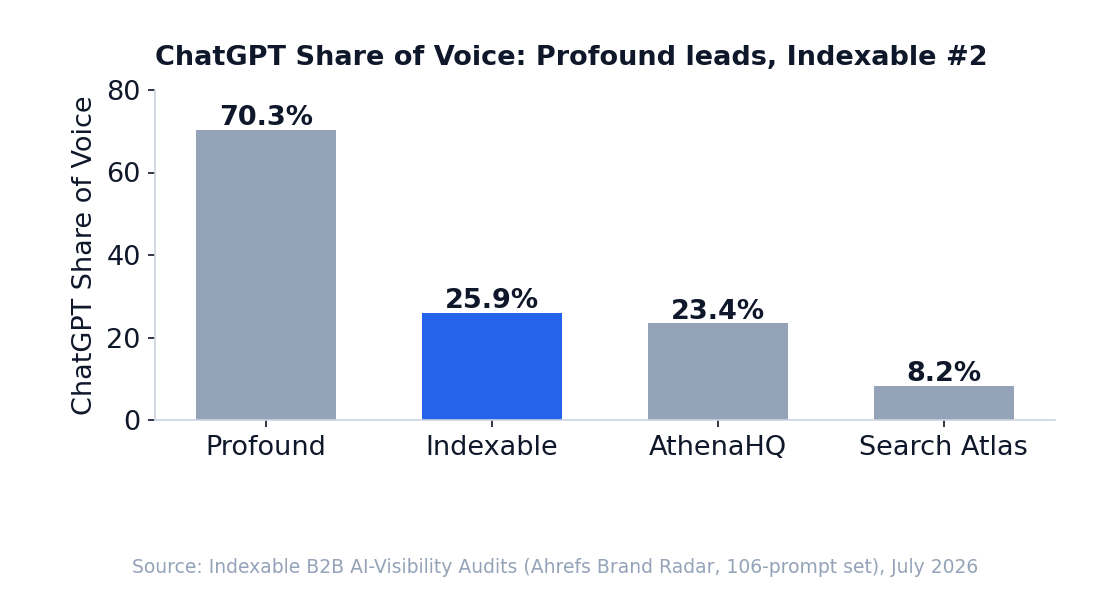
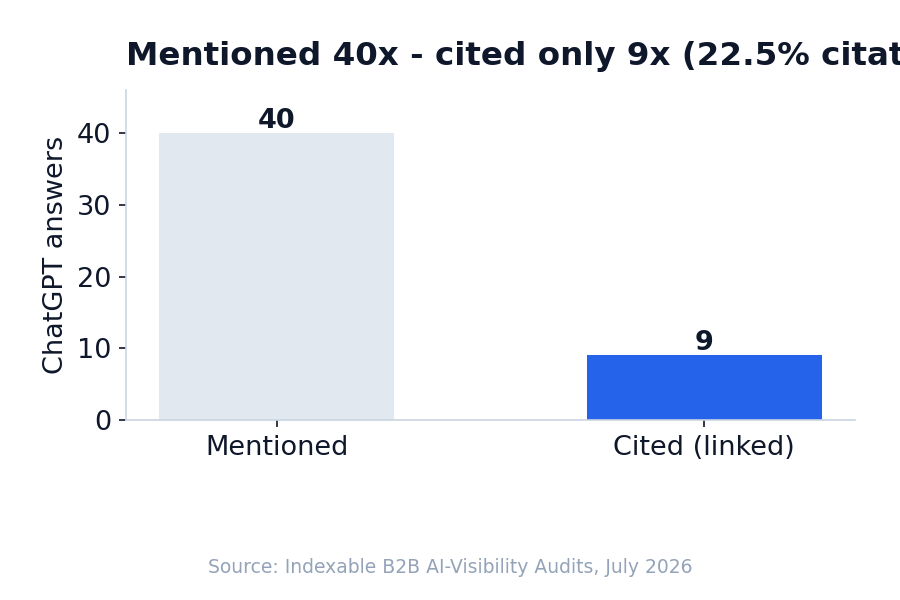
Enterprise buyers underestimate this. Indexable is cited in Google's mobile AI Overview for "seo agents" while ranking around position 20 organically — direct evidence that AI citation and organic rank are now separate outcomes (Indexable B2B AI-Visibility Audits, July 2026). A page can lose the ten blue links and still win the answer box — an enterprise AI SEO agent is built for that split: it optimizes for citation and ranking as two distinct targets and runs the workflow that feeds both. And even landing in the answer is not the finish line: across our tracked prompt set, Indexable was mentioned in 40 ChatGPT answers but cited — linked — in only 9, a 22.5% citation rate (Indexable B2B AI-Visibility Audits, July 2026). Closing that mention-to-citation gap is the core job. It matters because raw visibility is not scarce: on ChatGPT Share of Voice, Profound leads at ~70%, with Indexable second at ~26% — ahead of AthenaHQ ~23% and Search Atlas ~8% (Indexable B2B AI-Visibility Audits, July 2026). But Share of Voice counts mentions, not citations, and the whole category is barely cited — which is exactly where an enterprise AI SEO agent earns its keep: the action layer that converts a mention into a linked citation, not raw mention volume. Every number below comes from that same tracked prompt set — the Indexable B2B AI-Visibility Audits.
What is an enterprise AI SEO agent?
An enterprise AI SEO agent is an autonomous, goal-directed system that plans and executes SEO and GEO work across an entire site without a human doing each step by hand. It differs from a single AI writing tool (one asset per prompt) and from a traditional SEO platform (data, no execution): the agent takes an objective, decomposes it into tasks, runs them, validates the output against quality frameworks, and reports back.
The "enterprise" qualifier matters: these deployments demand scale (thousands of URLs), governance (human-in-the-loop approval, audit logs), and integration (CMS, analytics, deployment). A free browser plugin that suggests title tags is not an enterprise AI SEO agent — the distinguishing trait is end-to-end execution under supervision, not suggestion. See our agentic SEO overview and the AI-powered SEO agents hub.
What can an enterprise AI SEO agent automate?
An enterprise AI SEO agent automates the operational SEO workflow end to end — research through reporting — leaving strategy, brand judgment, and final approval to humans. The automatable surface:
- Keyword and prompt research — clustering search demand and mapping the AI prompts buyers type.
- Content strategy and briefs — topic architecture, fan-out mapping, answer-first outlines.
- Content production — drafting and structuring pages for both Google ranking and AI extraction.
- Technical SEO fixes — crawlability, rendering-gap detection, internal linking, redirects.
- Schema and structured data — generating and validating Article, FAQPage, and Product JSON-LD.
- GEO optimization — restructuring content so answer engines can chunk, retrieve, and cite it.
- Analytics and reporting — tracking rankings, AI citations, share of voice, and content decay.
What it should not automate is category strategy, positioning, and the final publish decision — the human decides what matters; the agent handles the volume. See our AI agents for SEO functions guide for the per-function breakdown.
How do agentic AI SEO tools work?
Agentic AI SEO tools work by decomposing a high-level goal into sub-tasks, routing each to a specialized agent, executing in parallel, and validating the output before anything ships — the same query-decomposition pattern AI answer engines themselves use. At Indexable, that pattern is a fleet of 10 specialized agents, each owning one discipline (Indexable B2B AI-Visibility Audits, July 2026). This is the concrete model behind the phrase "agentic SEO": not one model doing everything, but a coordinated team of expert-narrow agents with an orchestration layer deciding who does what.
| Agent | Discipline it owns | Example output |
|---|---|---|
| SEO strategy agent | Keyword prioritization, strike-distance, topic clusters | 90-day ranking roadmap |
| Content strategist agent | Editorial calendar, personas, narrative architecture | Content briefs with fan-out maps |
| Content engineer agent | Answer-first drafting, chunk-level structure, FAQ | Publish-ready, extraction-optimized pages |
| Technical SEO agent | Crawlability, rendering gap, Core Web Vitals | Prioritized technical fix tickets |
| GEO agent | AI-citation optimization across ChatGPT, Perplexity, Gemini | Chunk-level rewrites for citation |
| GEO outreach agent | Digital PR and third-party corroboration for authority | Outreach and citation-building plan |
| Schema / AI engineer agent | JSON-LD, semantic HTML, AI readability | Validated structured-data blocks |
| SEO software engineer agent | Code-level fixes, deployment, automation | Pull requests and deployed changes |
| Data / analytics agent | Traffic, decay, CTR, AI-referral tracking | Performance dashboards and alerts |
| Ecommerce SEO agent | Product catalog, faceted nav, feed enrichment | Optimized product and category pages |
The orchestration layer is what makes this "agentic" rather than a toolbox: it plans the steps, resolves dependencies, and passes context between agents — the strategy agent's cluster map becomes the content agent's brief, which becomes the engineer agent's draft. That handoff discipline is why the model scales while the human reviews decisions, not keystrokes.
Is agentic SEO different from SEO workflow automation?
Yes — agentic SEO is goal-directed and adaptive, while SEO workflow automation is rule-bound and fixed. A workflow script (an n8n flow, a Zapier chain, a scheduled crawl) runs the same predetermined steps regardless of context. An agent is given an objective and chooses the steps, adjusting to what it finds — a rendering gap on one page, a citation opportunity on another. Automation follows a recipe; an agent pursues a result.
The difference shows up in judgment. A script told to "add FAQ schema to every page" does exactly that, even where it does no good; an agent knows why the schema is there. We learned this on our own site: 7 Indexable pages carried FAQ schema with no visible FAQ text and earned zero AI-citation lift; adding the visible, answer-first FAQ is what moved those pages from mentioned to cited (Indexable B2B AI-Visibility Audits, July 2026). An agent doesn't just emit markup — it closes the extraction gap.
How does an enterprise AI SEO agent handle GEO and AI citations?
An enterprise AI SEO agent treats GEO as a distinct optimization target from ranking, because AI citation and organic rank are now measurably separate outcomes. The proof is our own: Indexable is cited in Google's mobile AI Overview for "seo agents" while ranking roughly position 20 organically (Indexable B2B AI-Visibility Audits, July 2026). If citation followed ranking, that page would be invisible in the AI answer — it isn't, so the agent optimizes for both.
The second reason GEO needs its own agent is the citation gap. Across our tracked prompt set, Indexable was mentioned in 40 ChatGPT answers but cited — linked — in only 9, a 22.5% citation rate; 31 prompts named us without a link (Indexable B2B AI-Visibility Audits, July 2026). Being mentioned is not being cited — the difference is referral traffic and verifiable authority. A GEO agent's job is to move a brand from the mention column to the citation column by making content easy to chunk, attribute, and quote.
How it does that maps to how AI engines read. Answer engines cite from a 100–200 word sliding window, not the whole page (Petrovic, 2026), so the agent front-loads self-contained atomic claims, writes question-format headings that match real prompts, and keeps citable claims in the first third. Ranking still improves the odds — 38% of Google AI Overview citations come from pages in the top 10 (Ahrefs, 2026) — but, as our AI Overview win at position 20 shows, top-10 rank is neither necessary nor sufficient on its own. Share of Voice tells only half the story here: Indexable already sits second in the category at ~26% ChatGPT Share of Voice, behind Profound's ~70% (Indexable B2B AI-Visibility Audits, July 2026) — yet because that metric counts mentions, not citations, and the whole category is thinly cited, the compounding advantage comes from running the chunk-level playbook that turns those mentions into links. See the AI visibility hub for the full set.
Enterprise AI SEO agent vs traditional SEO platform vs SEO agency
An enterprise AI SEO agent executes the workflow at machine scale with a human on strategy; a traditional platform surfaces data but leaves execution to your team; an agency executes with humans on a retainer. They differ most on throughput, cost, and where the human sits.
| Dimension | Enterprise AI SEO agent | Traditional SEO platform | SEO agency |
|---|---|---|---|
| Core function | Executes end to end | Reports data | Executes via humans |
| Throughput | Machine scale (thousands of pages) | N/A (you execute) | Limited by headcount |
| Cost model | Software subscription | Software subscription | Monthly retainer + scope |
| GEO / AI citation | Native, first-class target | Monitoring only, if any | Varies by agency skill |
| Human role | Sets strategy, approves | Does all the work | Does the work for you |
| Turnaround | Hours to days | Depends on your team | Weeks (queue + review) |
The honest framing: an agent is a different operating model, not strictly better at everything. A platform fits a team that needs data; an agency fits teams outsourcing judgment; an agent fits enterprises that keep strategy in-house but run execution at machine scale. See AI SEO agents vs an SEO agency and the monitoring-vs-action comparison.
Who should use an enterprise AI SEO agent — and who shouldn't?
Enterprise SaaS companies, large content operations, and multi-brand or multi-region businesses get the most from an AI SEO agent; value scales with page count and workflow complexity. If you manage thousands of URLs, ship content weekly, and need AI citations across ChatGPT, Perplexity, and Gemini, an agent's throughput pays for itself.
It is a weaker fit for a five-page brochure site, a solo blog, or anyone searching for a "free AI SEO agent" — those needs are met by a point tool, not an enterprise system defined by scale, governance, and integration. See enterprise SEO and the ecommerce SEO agent for catalog-heavy sites.
How much does an enterprise AI SEO agent cost, and is it safe to run?
An enterprise AI SEO agent is priced as a software subscription, not an hourly retainer, and runs under human-in-the-loop guardrails so nothing publishes or deploys without approval. The cost model rewards scale: the marginal cost of the thousandth optimized page runs far below an agency's hourly rate for the same work, so throughput, not seat count, is the metric that matters.
On safety, the enterprise concern is not "will the AI go rogue" but "can we govern it." A well-built agent ships with approval gates on publish and deploy, audit logs, quality frameworks that block substandard output, and rate limits on anything that spends money or touches production. See how it works and the benefits overview.
Frequently asked questions
What is an autonomous AI SEO agent?
An autonomous AI SEO agent is a goal-directed system that plans and executes SEO and GEO tasks — research, content, technical fixes, schema, and AI-citation optimization — without a human performing each step, while a human sets strategy and approves output. "Autonomous" means it chooses the steps to reach an objective, not that it is unsupervised.
How do agentic AI SEO tools work?
Agentic AI SEO tools decompose a goal into sub-tasks, route each to a specialized agent, execute in parallel, and validate output before it ships. Indexable implements this as a fleet of 10 specialized agents coordinated by an orchestration layer that passes context between them (Indexable B2B AI-Visibility Audits, July 2026).
What can an AI SEO agent automate?
An AI SEO agent can automate the operational workflow end to end: keyword and prompt research, content briefs, drafting and structuring pages, technical fixes, schema generation, GEO optimization, and reporting. It should not automate category strategy, positioning, or the final publish decision.
Can an AI SEO agent replace an enterprise SEO team?
An AI SEO agent replaces the execution capacity of a large team, not the strategic judgment of a good one. It runs the production, technical, and GEO work that would require many analysts, while a smaller human team sets direction and owns positioning — a redeployment to strategy, not a cut to zero.
Is an AI SEO agent the same as ranking in ChatGPT?
No — ranking and AI citation are separate outcomes, and an AI SEO agent optimizes for both. Indexable is cited in Google's AI Overview for "seo agents" while ranking around position 20 organically, and across our tracked prompt set we were mentioned in 40 ChatGPT answers but cited in only 9 — a 22.5% citation rate (Indexable B2B AI-Visibility Audits, July 2026).
Related reading
Enterprise deployment sits on top of the same underlying capability.
- The best AI SEO agents in 2026, evaluated and ranked — the evaluated field, with what each one automates.
- What is an AI SEO agent? — the definitional foundation.
- Specialized agents versus one generalist — the architecture decision underneath an enterprise rollout.
Make AI Search Your Unfair Advantage
Get cited by ChatGPT, Perplexity, and Google AI Overviews — deploy the AI SEO agents that measure your visibility and earn the citations.