What Marketing Leaders Ask Google About AI Search: 229 Questions, 90 Days, Zero Clicks
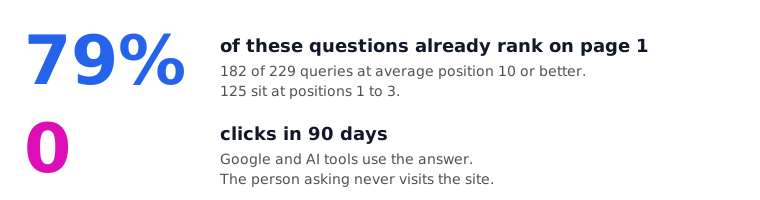
This is a first-party study of our own Google Search Console. In the 90 days to October 24, 2026, Google showed our site for 229 questions about a marketing leader's decision on AI search (CMO, VP, CFO, board). 182 of them (79%) already rank on page 1. They produced 0 clicks. The questions themselves are the useful part: a plain list of what marketing leaders want answered this quarter.
What did we measure, and how?
We pulled every query Google reported for our site over 90 days (6,558 queries) and kept the ones that mention a leadership role or a leadership decision. That left 229 queries with 888 impressions. Then we sorted them by theme, by role and by Google position. No keyword tool was involved. Every number on this page comes from our own Search Console export (Indexable AI, 2026).
Three honest caveats, because the data is small and the method is simple:
- A role word in the query does not prove a CMO typed it. It proves the question is about a CMO's decision.
- 83 of the 229 are written in the first person ("as a CMO at a large company…"). In our earlier study of 2,567 question queries, most long first-person questions came from AI tools asking Google on a person's behalf, not from a person at a keyboard (Indexable AI, 2026). Read this list as the questions marketing leaders, and the AI tools they use, put to Google.
- 888 impressions is a small sample. We publish counts and shares. We do not publish growth rates from it.
The full method, the regex that picked the roles, and the per-query file are in our pull record, so you can check the work.
What do marketing leaders want answered?
Three themes carry 190 of the 229 questions: which platform to shortlist (78), how to prove the return to a CFO or board (60), and how to report AI search to the board (52). Only 8 questions ask which KPIs to track. Leaders are past "what should I measure". They are asking "what do I buy, what do I say to finance, and what goes on the slide".
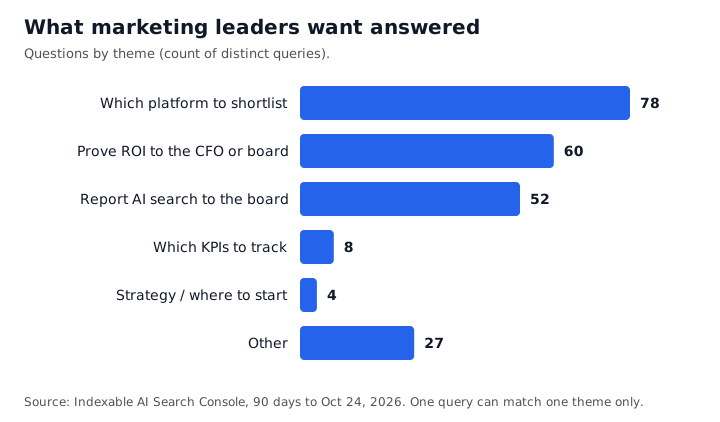
| Theme | Questions | On page 1 | A real example |
|---|---|---|---|
| Which platform to shortlist | 78 | 72 | "which enterprise seo platform has the best roi?" |
| Prove ROI to the CFO or board | 60 | 54 | "what's a defensible way to calculate the roi of an enterprise seo program for a board presentation including brand mentions in ai answers?" |
| Report AI search to the board | 52 | 33 | "how do i update my seo reporting for the cmo to include ai search?" |
| Which KPIs to track | 8 | 6 | "what kpis should a cmo use for ai search visibility?" |
| Strategy, where to start | 4 | 2 | "cmo ai visibility strategy" |
| Other | 27 | 15 | "seo for leadership" |
One question inside the "shortlist" theme is worth naming. The most-shown of the 78 (23 impressions, average position 2.3) asks for AI search platforms for enterprises that are "secure, compliant" and "integrate seamlessly with existing enterprise systems". The buyer is not asking for features. The buyer is asking what will survive procurement.
Who is asking?
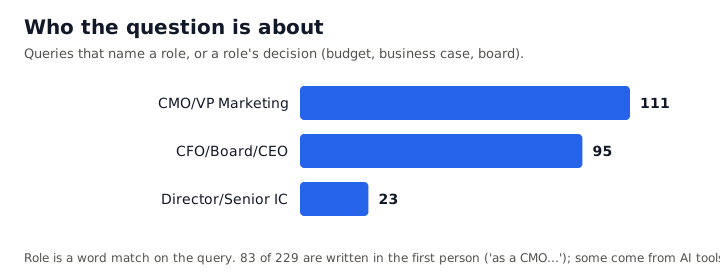
111 questions are about a CMO or VP of Marketing. 95 are about the CFO, CEO or board (the words "budget", "business case", "defensible" and "board" put a question in this group). 23 are about a director or a senior analyst. The CFO group ranks worst for us (average position 27 against 15 for the CMO group), which tells us where our own content is thinnest.
The analyst questions are the sharpest. One of them: "I'm an insights analyst. Which AI visibility platform has the most defensible measurement methodology to put in front of a skeptical CMO?" That is the whole buying problem in one sentence. The person who has to defend the number is choosing the tool.
Where do these questions rank, and why zero clicks?
182 of the 229 questions (79%) show our pages at an average position of 10 or better, and 125 sit at positions 1 to 3. The click count is still zero. For long questions Google now answers on the results page, through AI Overviews or AI Mode, and uses pages like ours as sources. The asker reads the answer and nobody visits.
This is not unique to us. Across all U.S. Google searches, 68% ended without a click in early 2026 (SparkToro, 2026). For 8-word questions from a marketing leader, the no-click share on our data is 100%.
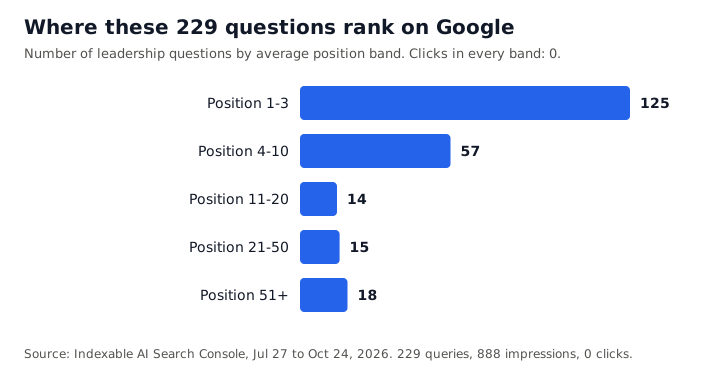
So ranking is not the problem to solve for this kind of question. Being the source Google and the AI tools use is half the job. Being named in the answer, so the leader remembers who told them, is the other half. We wrote up the difference between being cited and being named in our AI visibility work; the short version is that a citation is a footnote and a name is a recommendation.
The 12 questions worth copying into your plan
These are real queries from the export, with impressions and our average position. Use them as a planning list: if your team cannot answer each one in two sentences, that is the content, or the report, you are missing.
- "which enterprise seo platform has the best roi?" (53 impressions, position 1.6)
- "what's the roi on investing in an ai visibility platform?" (49, position 3.7)
- "how do i update my seo reporting for the cmo to include ai search?" (26, position 7.8)
- "what kpis should a cmo use for ai search visibility?" (12, position 2.5)
- "what's a defensible way to calculate the roi of an enterprise seo program for a board presentation including brand mentions in ai answers?" (12, position 3.0)
- "what's the minimum budget needed for enterprise seo software?" (12, position 3.2)
- "who can help a cmo understand the risks and opportunities of ai search?" (13, position 4.7)
- "how should cmos interpret ai visibility metrics alongside traditional performance kpis" (5, position 2.8)
- "can ai search analytics platforms integrate with ga4 to demonstrate roi to cfos?" (5, position 7.0)
- "the board still grades marketing on traffic and form fills, but with so many journeys ending inside an ai chat…" (4, position 3.2)
- "do any platforms produce a board-ready ai search visibility summary?" (2, position 3.5)
- "how to report on ai search visibility to the board" (2, position 1.0)
Read them in order and a story appears. First the budget question, then the KPI question, then the board question. The leader is building a case, not browsing.
What should a CMO do with this?
Use the list as a plan, not a report. The questions arrive in a fixed order: budget, then KPIs, then the board. So the work is three moves in that order: write the board line, pick two KPIs you can defend, and fix the pages that rank but never get named. Each move takes a week, not a quarter, and none of them needs a new tool to start.
- Write the board line first. One sentence: how often AI names your brand on your buyers' questions this quarter, next to your organic share, same period. You can copy the one-page format from our AI search board report template.
- Pick two KPIs, not five. Mention share (how often you are named) and cited sources (which of your pages AI used). The formulas are in the AI search metrics playbook. Start by tracking a fixed list of your buyers' questions, same wording every week.
- Treat page 1 with zero clicks as a naming problem. If AI uses your page and does not name you, the fix is in the page: a clear first sentence that says who you are and what you are best for, then the answer. Then, get the same sentence repeated on the sites AI trusts.
How to run this read on your own Search Console
You should be able to repeat this read in an afternoon with a spreadsheet and no paid tool. The point is to find the leadership questions your site already answers from page 1 and never gets a visit for, then fix those pages first. Here is how to do it, step by step:
- Export 90 days of queries from Search Console (Performance, Search results, Queries, export). Then, keep the columns query, clicks, impressions, position.
- Filter for role words: cmo, vp, head of marketing, cfo, ceo, board, executive, budget, business case, defensible.
- Remove job-title noise ("job description", vendor names with "ceo" in them).
- Tag each row with one theme: shortlist, ROI, board report, KPIs, strategy, other.
- Count queries and impressions per theme, and per position band (1 to 3, 4 to 10, 11 to 20, 21 to 50, 51 and beyond).
- Apply the test from the list above: can you answer each top question in two sentences? Implement the missing answers on the pages that already rank for them before you create anything new.
If you want us to run it for you on a call, schedule a strategy call and we will share the screen.
Frequently asked questions
Did 229 CMOs really search for this?
No, and we do not claim that. 229 queries mention a leadership role or decision. Some were typed by people, some by AI tools acting for people. The questions are real either way, and they are the point of the study.
Why does a page rank on page 1 and get zero clicks?
For long questions Google answers on the results page, through AI Overviews or AI Mode, and uses pages like ours as sources. The reader gets the answer without visiting. 68% of U.S. Google searches ended without a click in early 2026 (SparkToro, 2026).
Can I reuse these numbers?
Yes. Cite "Indexable AI, Search Console study, October 2026" and link this page. The pull record with the method is linked below.
What will you do next with this data?
We re-run the read every four weeks, and we are using the 12-question list to refresh the pages that already rank for them. The board report template was built because 52 of the questions asked for it.
Sources and notes
- Indexable AI, Google Search Console, property sc-domain:indexableai.com, web search, July 27 to October 24, 2026. Export of 6,558 queries; 229 kept. Pull record:
gsc-senior-manager-queries-2026-10-28(internal). - Indexable AI, question-query study of 2,567 Search Console questions, March 29 to October 4, 2026 (the human-like vs machine-like split).
- SparkToro, In 2026, less than one-third of Google searches still send a click (2026): 68% of U.S. Google searches ended without a click.
In summary: marketing leaders are asking Google what to buy, what to tell finance, and what to put on the board slide. Our pages answer those questions from page 1 and earn no visit. The next step for us, and for you, is to be named in the answer, not only used for it. Updated October 28, 2026.
See where AI names your competitors instead of you
A sample report shows the questions your buyers ask, who AI recommends, and the sources it used. A person approves every change before it goes live.