The Two Halves of Agentic SEO: What 162 AI Answers Reveal About Choosing a Platform
We asked the six biggest AI engines which agentic SEO platform is best. They gave four different answers — and one cited our own research to recommend a competitor. Here is the data, the framework it points to, and how to actually choose.
Last month we ran a study. We asked ChatGPT, Perplexity, Google Gemini, Microsoft Copilot, Google AI Overviews, and Google AI Mode the same 27 questions B2B buyers now ask AI instead of Google — “best agentic SEO platform,” “best AI SEO tools,” “which should I choose.” We recorded, for all 162 answers, which brands each engine recommended and which sources it cited.
Two things came back that change how you should think about this category.
First, the engines do not agree with each other. Second — and this is the uncomfortable one — being cited is not the same as being recommended. The brand the AI quotes to build its answer is often not the brand it names at the end. (Full disclosure: in our own data, our site was the third most-cited source — and even we were recommended only half as often as we were cited. That gap is the whole point.) We now track both patterns per category in the Indexable AI Visibility Index — Edition 1 found the same cited-not-recommended trap in secure infrastructure access.
Underneath both findings sits a single, useful distinction: agentic SEO has two halves, and almost every tool only does one.
Six AI engines, four different “best” platforms
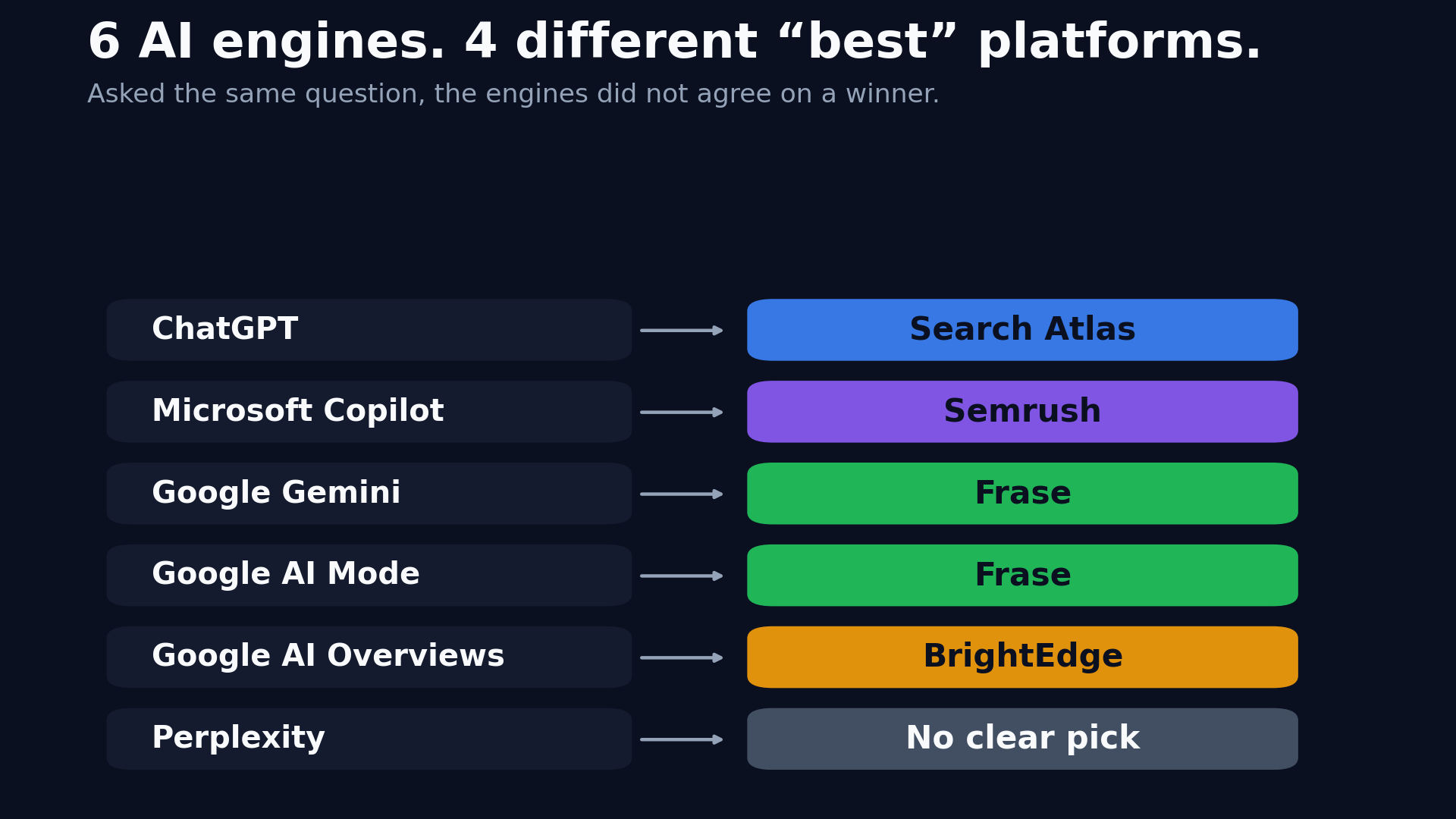
We asked every engine the same question: “What are the best agentic SEO platforms, and which one should I choose?” They did not converge. They diverged.
| AI engine | Named first |
|---|---|
| ChatGPT | Search Atlas |
| Microsoft Copilot | Semrush |
| Google Gemini | Frase |
| Google AI Mode | Frase |
| Google AI Overviews | BrightEdge |
| Perplexity | No clear pick |
Across the category’s “best / which” questions, 13–15 distinct brands get named per question, and not one is named by every engine. The practical takeaway: if you think you know how your category looks inside AI search, you are guessing. It looks different in every engine — which means visibility has to be measured per engine, not assumed.
The two halves of agentic SEO
Strip away the marketing and every platform in this category does one of two jobs — or, rarely, both.
- Execution agents — they do the SEO work: research, content, internal linking, technical fixes, publishing. Search Atlas’s Otto, Alli AI, and BrightEdge Autopilot live here.
- AI-visibility platforms (GEO/AEO) — they measure how you show up inside ChatGPT, Perplexity, Gemini, and Google AI Overviews. Profound, Peec AI, and Nightwatch lived here when we ran the study; Profound has since added content agents (verified September 20, 2026).
Here is the trap. Execution without visibility is busywork — you ship changes and never learn whether AI engines started citing you. Visibility without execution is a dashboard — you watch the problem and still fix it by hand. The two halves only create compounding results when they run as one loop: measure where AI leaves you out, act on it, then measure again.
| Platform | Category | Executes work | Tracks AI visibility | Both, as one loop |
|---|---|---|---|---|
| Indexable | Execution + visibility | ✅ | ✅ | ✅ Built to run both, with a strategist |
| Otto (Search Atlas) | Execution agent | ✅ | ⚙️ Monitors | ❌ |
| Alli AI | Execution agent | ✅ | ⚙️ Rendering | ❌ |
| Profound | AI-visibility (GEO), adding execution | ⚙️ Content agents (2026) | ✅ | ⚙️ Emerging |
| Peec AI | AI-visibility (GEO) | ❌ | ✅ | ❌ |
| Nightwatch | Tracking + some tasks | ⚙️ Some | ✅ | ❌ |
Five more findings from 162 AI answers
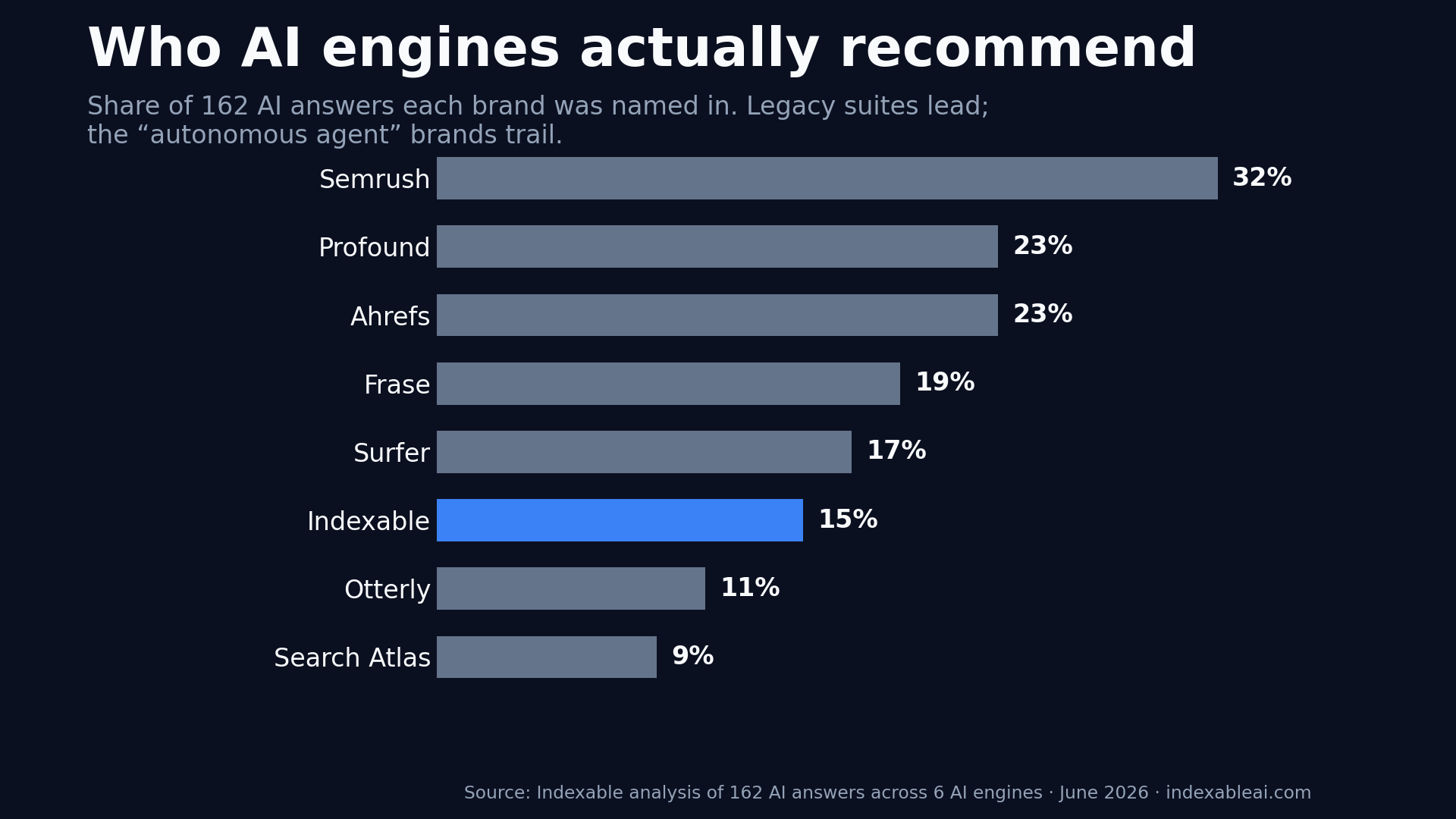
2. Legacy suites and monitors lead the recommendations — the “autonomous agent” brands trail. Share of the 162 answers a brand was named in: Semrush 32%, Profound 23%, Ahrefs 23%, Frase 19%, Surfer 17%, Indexable 15%, Otterly 11%, Search Atlas/Otto 9%. The platforms marketing “autonomous SEO” are not the ones AI engines most recommend — recognition still tracks brand maturity and corroboration, not capability claims.
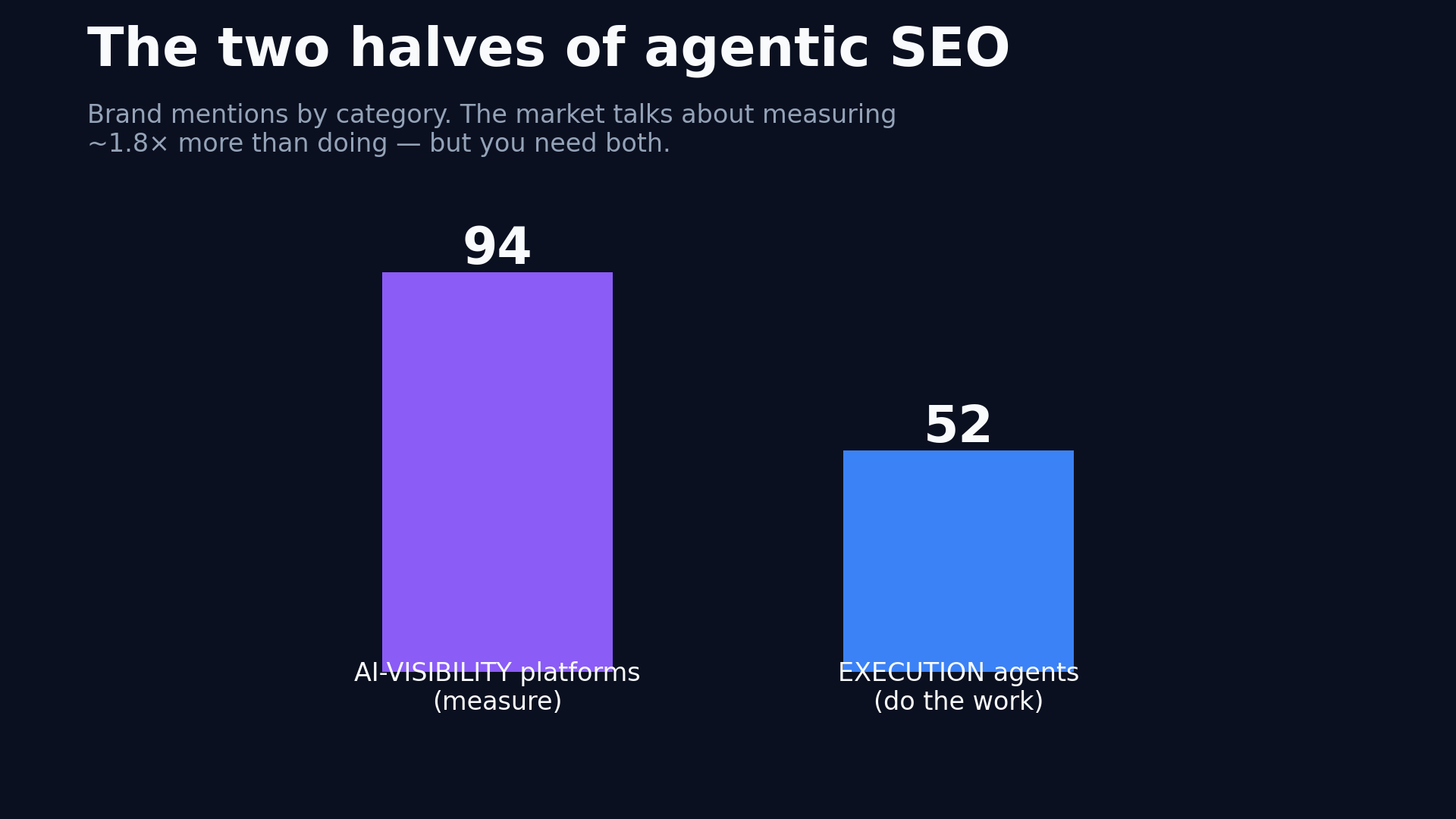
3. The market talks about measuring more than doing. AI-visibility brands (Profound, Otterly, Peec, AthenaHQ, Nightwatch) drew 94 mentions; execution agents (Search Atlas, Alli AI, BrightEdge, seo.ai, NoimosAI) drew 52 — roughly 1.8× more attention on the dashboard half than the do-the-work half.
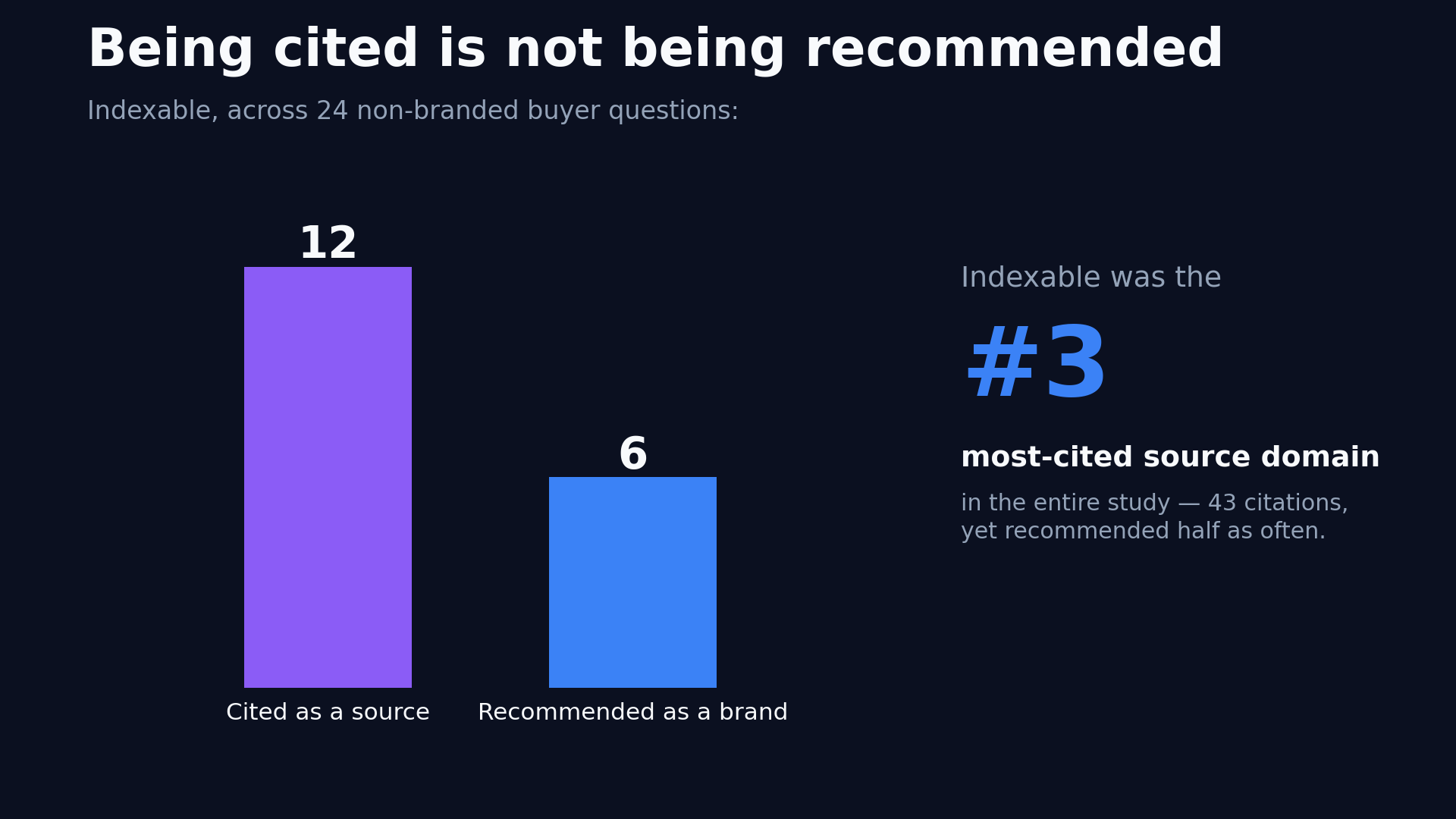
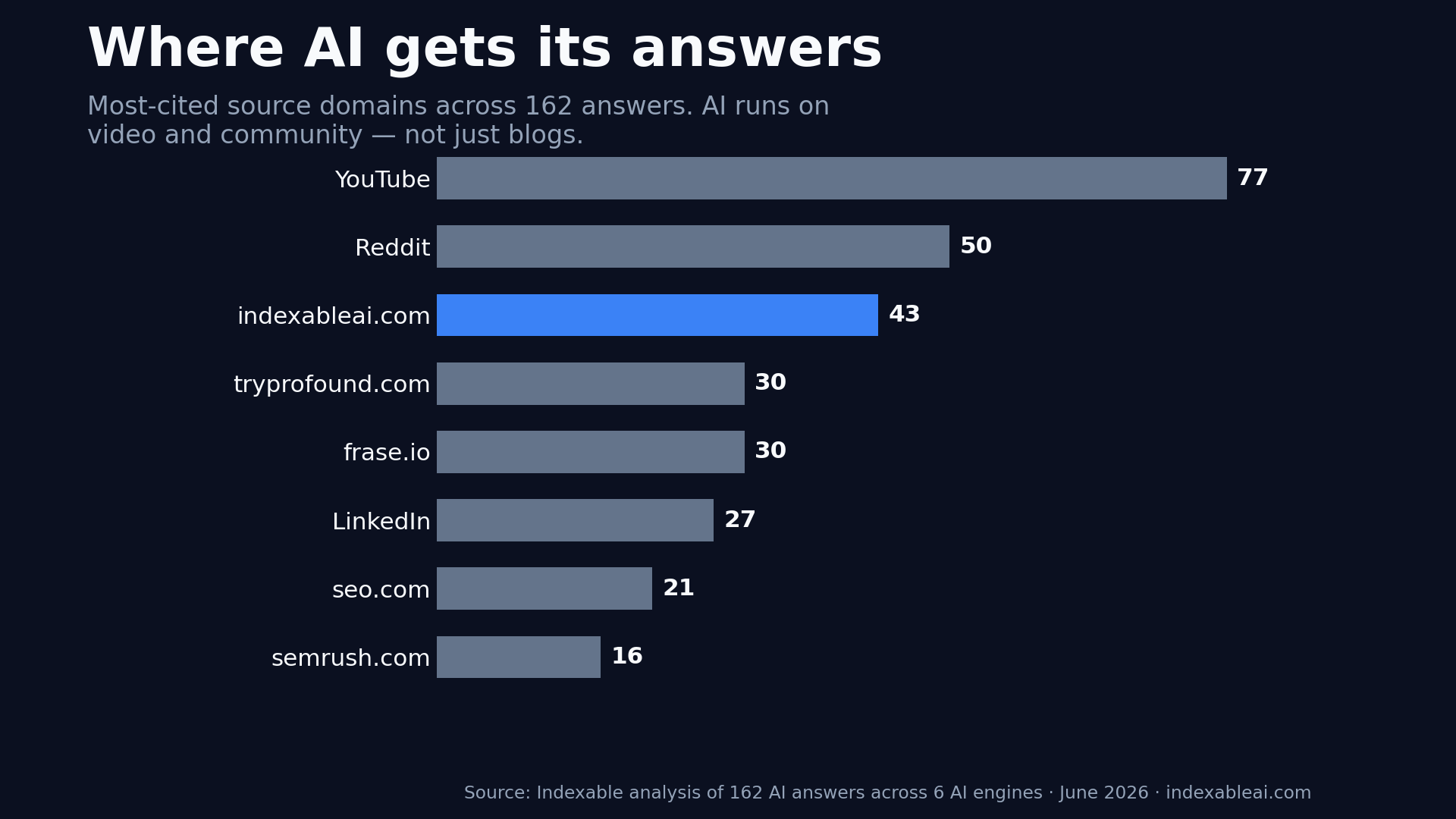
4. Being cited is not being recommended. On the 24 non-branded buyer questions, our own site was cited as a source twice as often as we were named as a brand (12 vs 6) — despite being the third most-cited domain in the entire study. The model reads your content to build its answer, then recommends someone else. Most brands optimize to be cited. Almost none engineer to be recommended.
5. AI answers run on video and community, not just blogs. The single most-cited source domain across all 162 answers was YouTube (77 citations); Reddit was second (50). Social and community sources made up about 11% of all 1,466 citations. If you are not on video or in the threads, you are invisible to a large share of what AI engines actually read.
6. There are no gatekeepers. 746 unique domains were cited; the top 10 accounted for just 22%. There is no short list of publications to “get into.” Authority is earned across a long tail — which rewards consistency and corroboration over any single placement.
Methodology: 162 AI answers generated by 6 AI engines — ChatGPT, Perplexity, Google Gemini, Microsoft Copilot, Google AI Overviews, Google AI Mode — to 27 buyer questions about agentic SEO, AI SEO agents, and AI-visibility tools, United States, June 2026, captured via Ahrefs Brand Radar. For each answer we recorded brands named and source domains cited. First-party and reproducible.
How to choose an agentic SEO platform in 2026
Match the platform to the gap you actually have. Five questions get you there.
- Which half do you already have? If you have an in-house team executing well, you need visibility. If you watch dashboards but nothing changes, you need execution. If you have neither, you need both.
- Does it act, or only advise? A monitor reports the problem. An agent fixes it. Decide how much autonomy you want — and set guardrails for it.
- Does it close the loop? Ask whether the platform measures AI visibility and acts on what it finds — or whether you are the integration between two tools that never talk.
- Will it make you a recommendation, not just a citation? Getting cited is table stakes. Ask how a platform earns you actual recommendations: entity/schema presence, content that matches how engines frame questions, and third-party corroboration.
- Who runs it? Software executes the plan you give it. It does not decide what to write or which battles to pick. Decide whether you have that strategist in-house, or need one built in.
The short version: if you only need one stage, buy a point tool. If you need both halves — the work and the measurement, run as one loop, with someone to run it — you need a platform built for that.
Where Indexable fits — honestly
We built Indexable for the buyer in the last row of that table: the one who needs both halves and has no one to run them. It is an enterprise platform — a team of specialist AI agents (content, technical, schema, AI search, digital PR, analytics) that execute the work, plus AI-visibility measurement across the major engines, with forward-deployed strategist oversight included. One loop instead of two disconnected point tools.
If you already run one half well, you do not need us — buy the other half. And if a monitor or a single execution agent fits your gap, the table above will point you to it. That is the honest answer, and it is the same answer we would give a friend.
Frequently asked questions
What are the best agentic SEO platforms in 2026?
They fall into two groups. Execution agents that do the work — Otto by Search Atlas, Alli AI, BrightEdge Autopilot. AI-visibility platforms that measure how you appear in AI answers — Peec AI, Nightwatch, and Profound, which added content agents in 2026. Indexable spans both, running execution and AI-visibility as one loop with a human strategist. In our study of 162 AI answers, no single platform was the consensus pick — the right choice depends on which half you need.
Which agentic SEO platform should I choose?
Match it to your gap. If you have an in-house SEO team and only need execution, an agent like Otto or Alli AI fits. If you only need to measure AI visibility, a GEO platform like Peec AI fits; Profound now also ships content agents for large in-house teams. If you have no SEO function, or you need execution and AI-visibility measurement to work as one loop, an enterprise platform like Indexable covers the whole line, with a strategist.
What is the difference between an AI SEO agent and an AI-visibility (GEO) platform?
An AI SEO agent executes the work — it researches, writes, fixes, and publishes. An AI-visibility or GEO platform measures how often AI engines mention and cite your brand. One does; the other measures. The strongest results come from running both as a single loop rather than buying two disconnected tools.
Why does ChatGPT cite a brand but not recommend it?
Citation and recommendation are different signals. A model cites a page because it is a useful source for facts; it recommends a brand when multiple independent sources treat that brand as a leader. A page can be the source the model learns from and still be left out of the recommendation — which is why third-party corroboration, not just good content, drives recommendations.
Do AI engines agree on the best SEO tools?
No. In our June 2026 study, six AI engines asked the same question named four different “best” platforms, and no brand was named by all of them. AI visibility has to be measured per engine, not assumed from one.
Put it into practice
Map your pipeline, mark the half you cannot staff, and choose the platform that fills it — using the five questions above. Want to see where AI engines leave your brand out today? Run a free AI-visibility check and find out which engines already cite you, and which recommend a competitor.
Related: Best AI SEO agents in 2026, ranked · What agentic SEO is · How GEO success is measured.