Four in Ten Questions, Zero Clicks: How AI Conversations Show Up in a CMO's Search Console
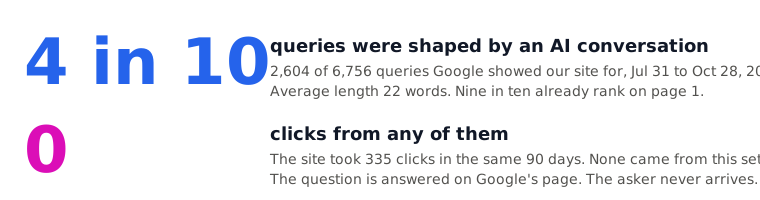
This is a first-party read of our own Google Search Console. In the 90 days to October 28, 2026, 2,604 of the 6,756 queries Google showed our site for were shaped by an AI conversation: long, question-form, often in the first person. Nine in ten rank on page 1. They produced 0 of our 335 clicks. For a CMO, that changes what the search dashboard is measuring.
- What is a conversation-shaped query, and how did we count them?
- What do these queries look like?
- Who is asking: people or software?
- Where do they rank, and why zero clicks?
- What are the conversations about?
- Does it stop at Google? What the answer engines cite
- What should a CMO change in the search report?
- How do you track AI Mode in Google Search Console?
- Frequently asked questions
What is a conversation-shaped query, and how did we count them?
A conversation-shaped query is a Search Console query that reads like a turn in a chat rather than a typed keyword: ten or more words, usually a full question, often "I" or "we", sometimes a pasted instruction. Google logs them because AI Mode and AI Overviews are counted inside the normal web search type, and every follow-up question in AI Mode is recorded as a new query (Google, 2025). The person asked an AI. Google fetched our page to answer. Search Console wrote it down.
We pulled every query for our site over 90 days (6,756 queries, 201,568 impressions, 335 clicks) and classified each one by shape, using the Search Console API and a rule-based classifier. The Search Console numbers involve no keyword tool. The one outside dataset on this page is Ahrefs Brand Radar, used in the section on answer engines and attributed where it appears. The full method and the per-query file are in our pull record (Indexable AI, 2026).
Four honest caveats before the numbers:
- Shape is not certainty. A long question can be typed on purpose. Read single rows as evidence and the totals as the finding.
- AI Mode and AI Overviews cannot be told apart at query level. Google folds both into web search (Google, 2025).
- Every count is a floor. Google removes rare, anonymised queries from the export.
- We cannot name the operator behind a machine-generated query. We can only recognise the template.
What do these queries look like?
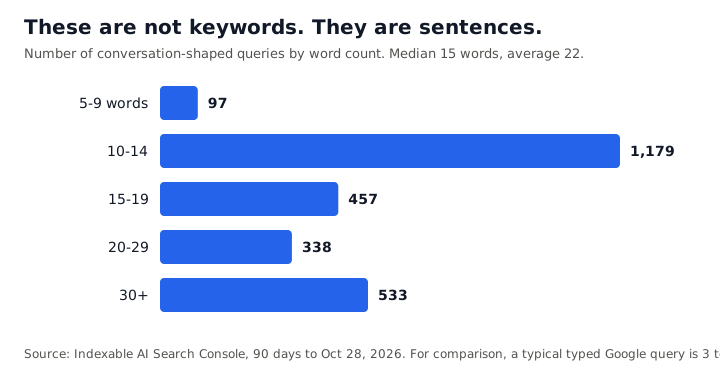
They look like briefs. The 2,604 conversation-shaped queries average 22 words, with a median of 15. 890 of the human-shaped ones are in the first person, 344 name a role (CMO, VP, director, founder, COO) and 148 are not in English. A typed Google query is three or four words. Your keyword report was never built to hold these.
Three real examples, each with its Google position and 90-day impressions, so you can hear the voice:
| Query, as logged | Words | Position | Impressions |
|---|---|---|---|
| "what are the most important kpis to track for geo ai citations and visibility?" | 14 | 5.2 | 1,110 |
| "i need an ai agent for seo and content that can find gaps, plan articles, and support execution. which platforms fit that use case?" | 23 | 2.5 | 96 |
| "our team needs an seo agent that can support content planning and search optimization. what software should we shortlist?" | 19 | 2.5 | 70 |
None of the three produced a click. The first one alone was shown 1,110 times.
Who is asking: people or software?
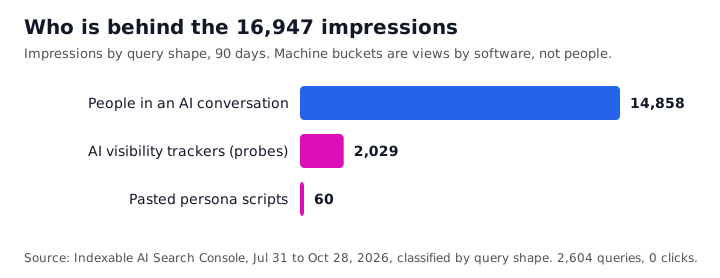
Mostly people, with a visible layer of software. 2,456 queries and 14,858 impressions have the shape of a human talking to an AI. 124 queries and 2,029 impressions are probes from AI visibility tracking tools, and 24 more are pasted persona scripts. That machine layer is one in eight of the conversation impressions, and it is not demand. It should never sit inside a traffic chart.
You can recognise the software by its templates. 36 queries follow the form "evaluate the AI visibility products company [name] on [criterion]" and carry 1,673 impressions between them. 95 end in "my location is spain" or "my location is germany", the signature of a tool that sets a country before it asks. The persona scripts are the strangest: a whole buyer profile ("i am a chief marketing officer in the technology industry… my main motivations…") pasted as a search.
For a CMO the point is simple. Your category is being benchmarked by software every day. If you run a tracker, some of these are your own probes coming back to you. If you do not, a competitor's tool is sweeping the questions you rank for. Either way, exclude them from demand and keep them as a watch list.
Where do they rank, and why zero clicks?
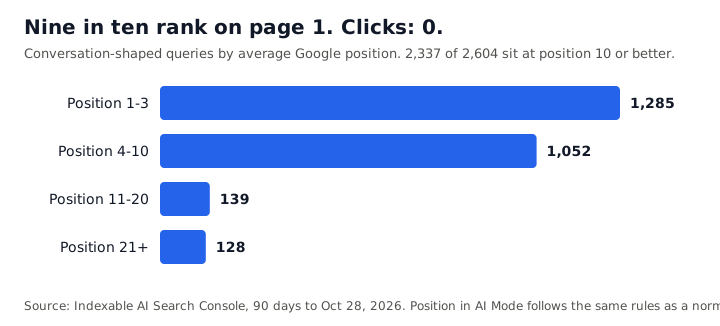
2,337 of the 2,604 queries, 89.7%, sit at an average position of 10 or better, and 1,285 sit at positions 1 to 3. The page-1 set drew 14,720 impressions and 0 clicks. The site took 335 clicks in the same 90 days, so this is not a site with no clicks. It is a set of questions answered before anyone needs to click.
The mechanism is documented. A link inside an AI Overview or an AI Mode answer only counts as a click when a person clicks it, and position in AI Mode follows the same rules as a normal results page (Google, 2025). So a page used as a source in the answer earns a page-1 impression, and the reader, who already has the answer, moves on. This is the same pattern we found twice before on smaller sets: nine page-one rankings with zero clicks in 28 days, and the 229 questions from marketing leaders, 79% on page 1, 0 clicks (Indexable AI, 2026). This read is the whole export. Across the whole US web, 68% of Google searches ended without a click in early 2026 (SparkToro, 2026). For conversation-shaped questions on our site the figure is 100%.
Is our site unusual? The share of queries that are conversation-shaped is ours alone, because only we can read our Search Console. What we can benchmark is how often Google answers the category's queries itself. Ahrefs Site Explorer lists the US keywords six AI search platforms rank for, including ours, with the features on each results page. On October 29, 2026, an AI Overview appeared on 248 of those 367 keywords, 67.6% (Ahrefs, 2026). By domain: 167 of 250, 29 of 31, 33 of 58, 11 of 18, 8 of 10, and one domain with no US keywords indexed. The category's buyers get an AI answer on two keywords in three before they see a single link, so a high share of answered-not-clicked questions is the norm here, not a quirk of our site.
What are the conversations about?
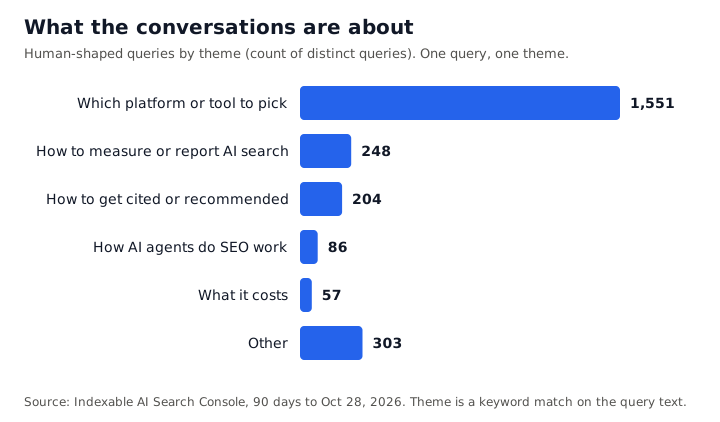
Buying. 1,551 of the human-shaped queries ask which platform or tool to pick, with 8,314 impressions. 248 ask how to measure or report AI search. 204 ask how to get cited or recommended by AI. 86 ask how AI agents do SEO work, and 57 ask what it costs. Our SEO Manager agent's intent classifier reads the same set as 1,262 informational, 922 commercial investigation and 246 transactional queries. Half of the conversations are a shortlist being built.
Then, look at which pages carry them. 107 of our pages appeared for at least one conversation-shaped query. Five pages carry more than half the impressions: the enterprise SEO platforms guide (3,150), the enterprise SEO pricing guide (1,962), the AI visibility hub (1,764), the AI search metrics playbook (1,622) and the AI SEO agents guide (1,042). These are long, structured pages with tables and direct answers. That is what an answer engine quotes.
Does it stop at Google? What the answer engines cite
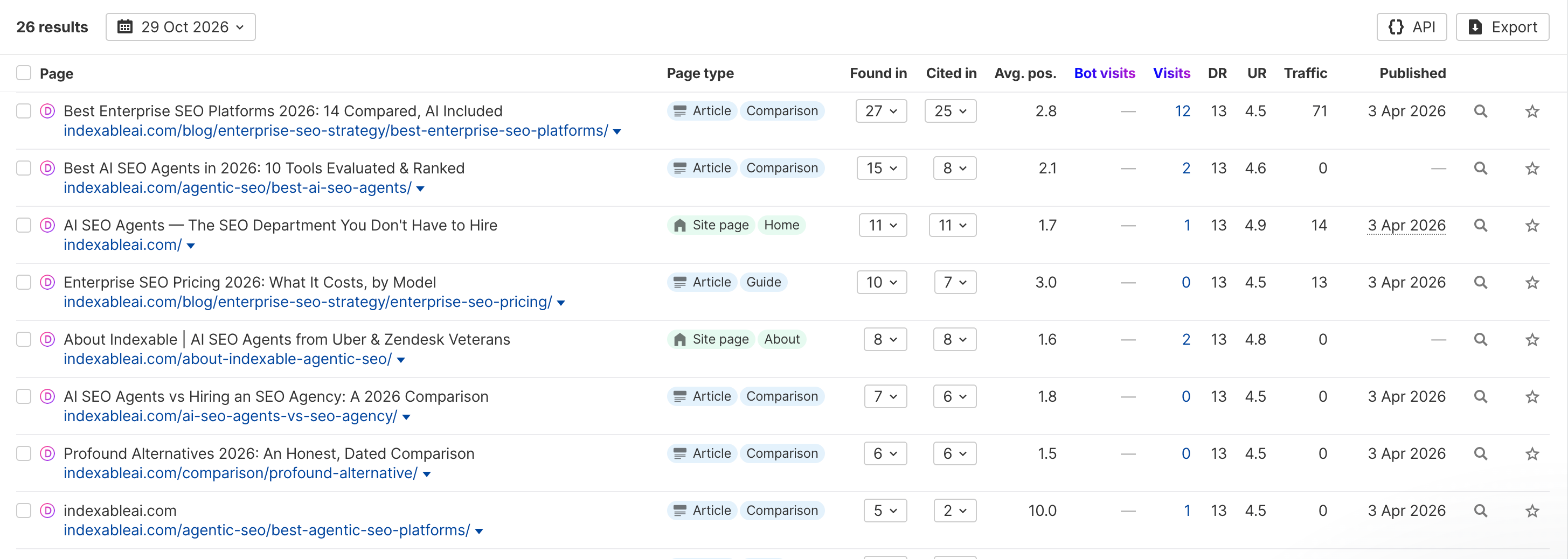
No. Search Console can only show Google. To see the other engines we used Ahrefs Brand Radar, which asks a fixed set of prompts to seven AI engines and records every page each answer cites. On October 29, 2026 we read 500 answers to our 129 tracked prompts. 72 of the 500 cited a page on our site: ChatGPT 21 of 125, Claude 12 of 54, Perplexity 11 of 125, Google AI Overviews 10 of 72, Google AI Mode 10 of 54, Copilot 5 of 35, Gemini 3 of 35 (Ahrefs Brand Radar, 2026).
The page the engines cite most is the page that carries the most conversation-shaped impressions in Search Console. Our enterprise SEO platforms guide was cited in 24 of the 72 citing answers, and in 9 of the 20 Google AI Mode and AI Overviews answers that cited us at all. The same guide carried 3,150 conversation impressions in Search Console, more than any other page. That is the bridge between the two reads: an answer engine quotes the page, Google logs the question, and the person who asked never arrives.
| Page | Conversation impressions (Search Console) | Answers citing it, all checks to Oct 29 (Ahrefs Brand Radar) |
|---|---|---|
| Enterprise SEO platforms guide | 3,150 | 25 |
| AI SEO agents guide | 1,042 | 8 |
| Profound alternative comparison | 331 | 6 |
| Enterprise SEO pricing guide | 1,962 | 7 |
| AI search metrics playbook | 1,622 | 0 |
One page breaks the pattern, and it is the useful one. The metrics playbook carries 1,622 conversation impressions on Google and has never been cited by any of the seven engines in Brand Radar. Google's AI reads it; the answer engines do not. For a CMO that is the actionable gap: the pages your buyers' questions already land on are not yet the pages the other engines trust, and the fix is a content and citation job, not a dashboard job.
One honest limit: 500 answers on 129 prompts is our prompt set, chosen around our category. It is a read of our visibility, not a census of the engines. We re-run it every two weeks and the counts move.
What should a CMO change in the search report?
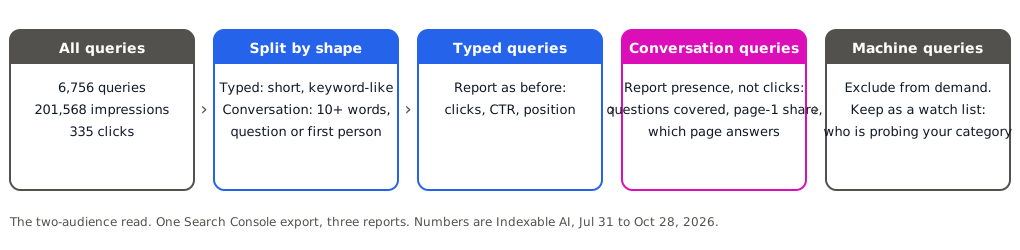
Change the KPI, not just the chart. For the typed audience, clicks still measure search. For the conversation audience, clicks measure nothing, and the KPI that does is presence: the count of buyer questions your pages answered, and the share of them on page 1. On our site that KPI is 2,604 questions and 89.7%, and it is the number that goes on the slide. Clicks for that audience are 0, and they always will be. We call the fix the two-audience read, and you can build it from one Search Console export.
Key facts to put on the slide:
- Google AI Mode passed one billion monthly users by May 2026 (Google, 2026).
- ChatGPT has 1.2 billion weekly users (OpenAI, 2026).
- 68% of US Google searches ended without a click in early 2026 (SparkToro, 2026).
- On our own site, 38.5% of queries in 90 days were conversation-shaped and 100% of them ended without a click (Indexable AI, 2026).
You can start by adding one column to the query export: shape. Mark a query as conversation-shaped when it has ten or more words, or opens with a question word, or contains "I", "my", "we" or "our". Then, report the two sets separately. For typed queries, keep clicks, click-through rate and position. For conversation queries, report presence: how many distinct questions you appeared for, what share sit on page 1, and which page answered. You should pull the machine templates out of both sets before you total anything, and keep them in a third tab as a watch list of who is probing your category.
Implement a monthly read of the question list itself. It is the closest thing you will get to a transcript of your buyer's thinking: 1,551 shortlist questions is a better brief than any survey we have run. Apply it to the pages that already carry the impressions, because Google is already quoting them. Our one-page AI search board report has a slot for these numbers, and the CMO use case shows how our agents keep both reads current.
One number this read cannot give you is whether the AI named you in the answer. Search Console shows that your page was used, and Brand Radar shows which engines cited it. Neither shows whether the reader heard your name or a competitor's. That needs a direct check of the answer text, which is the AI visibility work we do with our agents, and it is why we treat Search Console as the first of three reads, not the whole picture.
How do you track AI Mode in Google Search Console?
You cannot filter for AI Mode directly. Google reports AI Mode and AI Overviews inside the web search type, with no separate toggle, and a follow-up in AI Mode is counted as a new query (Google, 2025). What you can do is read the shape of the queries, which is what this study did. Here is the read in five steps, no tools beyond Search Console and a spreadsheet:
- Export the Performance report for the last 90 days, web search type, query dimension. Use the API if you have more than 1,000 queries, because the interface caps the export.
- Add a word count column. Flag every query with ten or more words.
- Add a shape column. Flag queries that open with what, how, which, who, why, is, are, do, does, can or should, and queries containing "I", "I'm", "my", "we" or "our".
- Pull out the machines. Look for repeated templates: the same opening phrase with one changing word, a trailing "my location is", or pasted blocks of profile text. Move them to a watch-list tab.
- Report presence, not clicks, for what remains: distinct questions, page-1 share, and the top five pages that carried them. Repeat monthly and compare counts, not growth rates, until you have six months of data.
Our 90-day read came out at 38.5% of queries, 8.4% of impressions and 0% of clicks. We re-run it every four weeks and update this page. Contact us if you want the classifier rules; they are short and we will share them.
Frequently asked questions
Does Google Search Console show AI Mode and AI Overviews data?
Yes, but not separately. Google counts both inside the web search type in the Performance report, applies standard impression rules, and counts a click on a link inside the answer as a click (Google, 2025). There is no filter to isolate them, so the query shape is the only query-level signal available.
Are these queries really from AI conversations?
The shape says so, and Google's documentation explains how they get there, but we cannot prove any single row. Some long questions are typed on purpose. That is why we publish counts for the whole set and caveat the single examples.
Why does this matter to a CMO rather than the SEO team?
Because the dashboard the CMO sees still reports clicks as the measure of search, and for four in ten of our queries clicks cannot measure anything. The decision about what the board is shown is a CMO decision. The classifier is the SEO team's job.
Can I reuse these numbers?
Yes. Cite Indexable AI, Search Console study, October 2026, and link this page. The per-query file is linked below, and the full pull record with the method and caveats is available on request.
Sources and notes
- Indexable AI (2026). Search Console query export, July 31 to October 28, 2026, classified by query shape. Per-query file: ai-conversation-queries-90d.csv (2,604 rows: query, bucket, theme, words, impressions, clicks, position, page). The classifier rules and the full pull record are available on request.
- Indexable AI (2026). What marketing leaders ask Google about AI search: 229 questions, 90 days, zero clicks.
- Ahrefs Brand Radar (2026). 500 answers to 129 tracked prompts across ChatGPT, Perplexity, Claude, Google AI Overviews, Google AI Mode, Copilot and Gemini, read October 29, 2026, with every cited page per answer. Data used with attribution to Ahrefs.
- Ahrefs Site Explorer (2026). Organic keywords, United States, October 29, 2026, for indexableai.com, tryprofound.com, athenahq.ai, peec.ai, otterly.ai and scrunch.ai; SERP features per keyword. Data used with attribution to Ahrefs.
- Google Search Central (2025). AI features and your website, updated December 10, 2025; and Search Console Help, Performance report (AI Mode follow-ups counted as new queries; standard impression and click rules).
- Google (2026). Search at I/O 2026: AI Mode past one billion monthly users.
- OpenAI (2026). DevDay 2026 recap: 1.2 billion weekly ChatGPT users.
- SparkToro (2026). In 2026, less than one third of Google searches still send a click: 68% zero-click in the US.
In summary: four in ten of the questions Google shows our site for now come out of AI conversations, nine in ten already rank on page 1, none of them clicks, and the page Google's AI quotes most is the page the other engines cite most. Report that audience by presence, keep the machines out of the totals, and read the questions as the brief they are.
See whether AI names you, or only reads you
Search Console shows your pages are being used. Our agents check the answer engines directly, find where AI recommends a competitor instead of you, and write the fixes for a person to approve.